


Multicolor多色流式分型Mini Panel - Macrophage 人


巨噬细胞(macrophage)是一种位于组织内的白细胞,源自单核细胞,而单核细胞又来源于骨髓中的前体细胞。巨噬细胞和单核细胞皆为吞噬细胞,在脊椎动物体内参与非特异性防卫(先天性免疫)和特异性防卫(细胞免疫)。它们的主要功能是以固定细胞或游离细胞的形式,对死亡细胞、细胞残片及病原体进行噬菌作用(吞噬与消化),并激活淋巴细胞或其他免疫细胞,加快其对病原体作出反应的时间。

- 最新进展
- 产品信息
最新进展
MultiColor多色流式分型Mini Panel之巨噬细胞
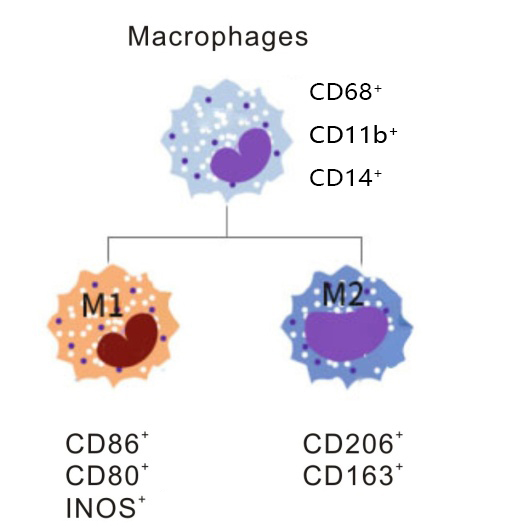
巨噬细胞(macrophage)是一种位于组织内的白细胞,源自单核细胞,而单核细胞又来源于骨髓中的前体细胞。巨噬细胞和单核细胞皆为吞噬细胞,在脊椎动物体内参与非特异性防卫(先天性免疫)和特异性防卫(细胞免疫)。它们的主要功能是以固定细胞或游离细胞的形式,对死亡细胞、细胞残片及病原体进行噬菌作用(吞噬与消化),并激活淋巴细胞或其他免疫细胞,加快其对病原体作出反应的时间。
Panel推荐:
|
指标 |
荧光素 |
最大EX/EM(nm) |
对应激光器 |
滤光片 |
产品编号 |
规格(1 T为一次实验) |
|
CD45 |
APC-Cy7 |
659/782 |
红激光 |
780/60 |
20/50/100/500 T可选 |
|
|
CD68 |
Alexa Fluor® 647 |
653/669 |
红激光 |
660/20 |
20/50/100/500 T可选 |
|
|
CD86 |
PE二选一即可 |
496,566/576 |
蓝激光或黄激光 |
575/26 |
20/50/100/500 T可选 |
|
|
CD80 |
PE二选一即可 |
496,566/576 |
蓝激光或黄激光 |
575/26 |
20/50/100/500 T可选 |
|
|
CD206 |
Alexa Fluor® 488 |
494/517 |
蓝激光 |
530/30 |
20/50/100/500 T可选 |
注:
- CD68检测需要破胞膜;
- 无法用单纯的CD11b或CD14替代CD68,他们分别代表所有髓系细胞及总单核细胞,一般方案里共染是辅助CD68分群;
- M2也可选择CD163等标志物。
各抗体指标功能详解:
|
CD antigen |
Cellular expression |
Molecular weight (kDa) |
Functions |
|
CD45 |
All hematopoietic cells |
180–240 (multiple isoforms) |
Tyrosine phosphatase, augments signaling through antigen receptor of B and T cells, multiple isoforms result from alternative splicing (see below) |
|
CD68 |
Monocytes, macrophages, neutrophils, basophils, large lymphocytes |
110 |
Lysosomal markers: involved in intracellular degradation and antigen processing. Phagocytosis: Identifying apoptotic cells and pathogen associated molecular patterns. Diagnostic application: markers of Macrophages in histopathology. |
|
CD80 |
Antigen presenting cells (APCs): Dendritic cells, macrophages, activated B cells. Under inflammatory conditions, T cells and NK cells can induce expression. |
60 |
Co-stimulator, ligand for CD28 and CTLA-4 |
|
CD86 |
Monocytes, activated B cells, dendritic cells |
80 |
Ligand for CD28 and CTLA4 |
|
CD206 |
Macrophages, endothelial cells |
175-190 |
Type I membrane glycoprotein; only known example of a C-type lectin that contains multiple C-type CRDs (carbohydrate-recognition domains); it binds high-mannose structures on the surface of potentially pathogenic viruses, bacteria, and fungi |
|
||||||||||||||||||||||||||||||||||||||||||||||||||||||





产品信息
本文由斯达特技术专家团审核发布
声明:本篇文章在创作中部分采用了人工智能辅助。如有任何内容涉及版权或知识产权问题,敬请告知,我们承诺将在第一时间核实并撤下。
杭州斯达特 (www.starter-bio.com)是优宁维旗下品牌,志在为全球生命科学行业提供优质的抗体、蛋白、试剂盒等产品及研发服务。依托多个开发平台:重组兔单抗、重组鼠单抗、快速鼠单抗、重组蛋白开发平台(E.coli,CHO,HEK293,InsectCells)、一步法ELISA平台,PTM泛修饰抗体平台,已正式通过欧盟98/79/EC认证、ISO9001认证、ISO13485认证。
 查看更多产品