




 分享
分享产品介绍 评论(0)
物种
Human表达序列
Leu36-Tyr482表达宿主
CHO分子量
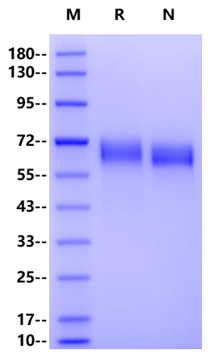
60-70kDa (Reducing)
纯度
>95% by SDS-PAGE
内毒素含量
<0.1EU/μg活性
The Hyaluronidase PH20, Human have been assayed by turbidimetric, according to Pharmacopoeia of the People's Republic of China, the Specific activity is >60000 IU/mg.标记
Unconjugated标签
No Tag性状
Lyophilized Powder缓冲体系
20mM PB, 150mM NaCl, pH7.4溶解方法
Reconstitute at 0.1-1 mg/ml according to the size in ultrapure water after rapid centrifugation.储存条件
· 12 months from date of receipt, -20 to -70 °C as supplied.
· 6 months, -20 to -70 °C under sterile conditions after reconstitution.
· 1 week, 2 to 8 °C under sterile conditions after reconstitution.
· Please avoid repeated freeze-thaw cycles.
Hyaluronidases are a group of glycosidases catalyzing the degradation of hyaluronic acid (HA). There are six known types (hyaluronidase 1–4, PH-20, and HYALP1). Human hyaluronidase is present both in organs (testis, spleen, skin, eyes, liver, kidneys, uterus, and placenta) and body fluids (tears, blood, and semen). Testicular PH20 hyaluronidase is found on the surface of human sperm and inner acrosomal membrane and degrades hyaluronic acid in the ovum during fertilization. Hyaluronidase PH20 is known as sperm adhesion molecule 1 (SPAM1) and random hydrolysis of (1, 4)-linkages between N-acetyl- beta-D-glucosamine and D-glucuronate residues in hyaluronic acid (HA). PH20/SPAM1 involved in sperm-egg adhesion. Upon fertilization sperm must first penetrate a layer of cumulus cells that surrounds the egg before reaching the zona pellucida. The cumulus cells are embedded in a matrix containing hyaluronic acid which is formed prior to ovulation. PH20/SPAM1 protein aids in penetrating the layer of cumulus cells by digesting hyaluronic acid.
电泳
- 1μg (R: reducing condition, N: non-reducing condition).

评论(0)