




 分享
分享产品介绍 评论(0)
物种
Human分子别名
Transforming growth factor beta-1, TGF-beta-1Accession
P01137表达序列
Ala279-Ser390
表达宿主
CHO分子量
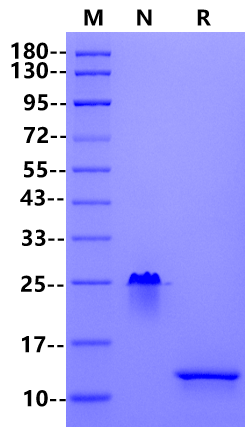
13 kDa (Reducing)
纯度
>95% by SDS-PAGE and HPLC.内毒素含量
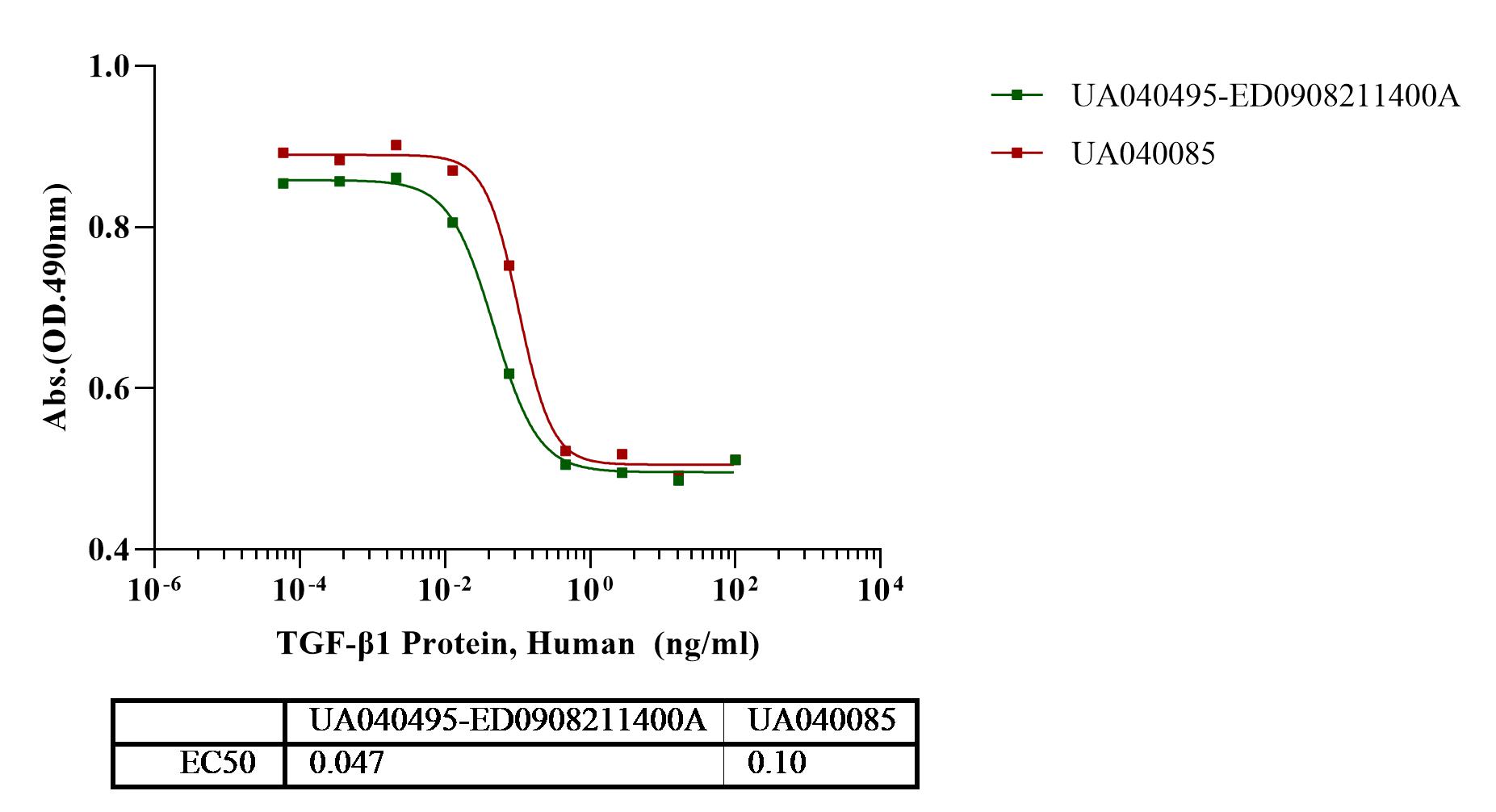
<0.1EU/μg活性
EC50 < 0.1ng/ml标记
Unconjugated标签
No Tag性状
Lyophilized Powder缓冲体系
4mM HCl
溶解方法
Reconstitute at 0.1-1 mg/ml according to the size in reconstitution buffer after rapid centrifugation.
储存条件
·12 months from date of receipt, lyophilized powder stored at -20 to -80℃.
·3 months, -20 to -80℃ under sterile conditions after reconstitution.
·1 week, 2 to 8℃ under sterile conditions after reconstitution.
·Please avoid repeated freeze-thaw cycles.文献引用
Nat Rev Mol Cell Biol. 2012 Oct;13(10):616-30.
Nat Rev Clin Oncol. 2021 Jan;18(1):9-34.
Human transforming growth factor-beta 1 (TGF-β1) is a 25 kDa disulfide-linked homodimeric cytokine that belongs to the TGF-β superfamily. It is synthesized as a 390-aa precursor; after cleavage, the mature 112-aa chain remains non-covalently associated with the latency-associated peptide (LAP) to form the small latent complex (SLC). Further association with latent TGF-β-binding proteins (LTBPs) generates the large latent complex (LLC) that is deposited in the extracellular matrix. Physiological activation requires proteolytic or conformational release of the mature dimer, which then signals through a hetero-tetrameric receptor complex of TβRII and TβRI/ALK5 to phosphorylate receptor-regulated Smads (Smad2/3). TGF-β1 is produced by virtually every cell type, but platelets and bone are its richest sources in humans.
Functionally, TGF-β1 is a pleiotropic master regulator of cell proliferation, differentiation, apoptosis, extracellular-matrix (ECM) production and immune tolerance. It maintains homeostasis by inhibiting epithelial, endothelial and hematopoietic cell growth while stimulating mesenchymal cells and driving epithelial-to-mesenchymal transition (EMT). In the immune system it polarizes naïve CD4⁺ T-cells toward Foxp3⁺ regulatory T cells (iTreg) or, in the presence of IL-6, toward Th17 cells, and it suppresses macrophage activation and B-cell proliferation. In bone, TGF-β1 recruits and stimulates osteoblast lineage cells and couples resorption to formation. Deregulated TGF-β1 signaling is a hallmark of fibrosis, autoimmune diseases and cancer: early tumors are growth-inhibited by TGF-β1, whereas advanced carcinomas exploit autocrine TGF-β1 to invade, metastasize and evade immunity.
生物活性
Measured by its ability to inhibit the IL-4-dependent proliferation of HT‑2 mouse T cells. The EC50 for this effect is less than 0.1ng/ml.
电泳
2μg (R: reducing condition, N: non-reducing condition).
反相高效液相色谱(RP-HPLC)
>95% as determined by RP-HPLC.

评论(0)