




 分享
分享产品介绍 评论(0)
物种
Rat分子别名
Interleukin-4; IL-4; B-cell IGG differentiation factor; B-cell growth factor 1; B-cell stimulatory factor 1 (BSF-1); Lymphocyte stimulatory factor 1;Accession
P20096表达序列
His23-Ser147
表达宿主
HEK293分子量
17-20 kDa (Reducing)
纯度
>95% by SDS-PAGE; >90% by HPLC内毒素含量
<0.1EU/μg标记
Unconjugated标签
No Tag性状
Lyophilized Powder缓冲体系
PBS, pH7.4
溶解方法
Reconstitute at 0.1-1 mg/ml according to the size in ultrapure water after rapid centrifugation.
储存条件
·12 months from date of receipt, lyophilized powder stored at -20 to -80℃.
·3 months, -20 to -80℃ under sterile conditions after reconstitution.
·1 week, 2 to 8℃ under sterile conditions after reconstitution.
·Please avoid repeated freeze-thaw cycles.文献引用
Cytokine. 2015 Sep;75(1):3-7.
J Allergy Clin Immunol. 2022 Aug;150(2):266-276.
Interleukin-4 (IL-4) is a 13–18 kDa, glycosylated, four-α-helix cytokine that was originally described in the rat as “B-cell stimulatory factor-1”. It is synthesized with a 24-aa signal peptide and, once cleaved, the mature rat protein shares ≈41 %, 43 % and 59 % amino-acid identity with bovine, human and mouse IL-4, respectively; cross-species bio-activity is negligible, making rat-specific reagents essential for in-vivo and ex-vivo work. In the rat, IL-4 is produced chiefly by Th2-polarized CD4⁺ T cells, mast cells, basophils and eosinophils, and signals through two receptor heterodimers: the type-I receptor (IL-4Rα + common γ-chain) found on haematopoietic cells, and the type-II receptor (IL-4Rα + IL-13Rα1) expressed on non-haematopoietic cells and shared with IL-13. Engagement of either complex triggers JAK1/3-STAT6 phosphorylation and, secondarily, the IRS-2/PI3K pathway, leading to characteristic Th2 effector functions: IgE and IgG1 class-switching in B cells, alternative (M2) activation of macrophages, mucus production by airway epithelium, and chemotaxis of eosinophils and mast cells. Consequently, IL-4 is the central driver of allergic airway inflammation in rat models of asthma and is routinely used to skew splenocyte cultures toward a Th2 phenotype in vitro.
免疫印迹
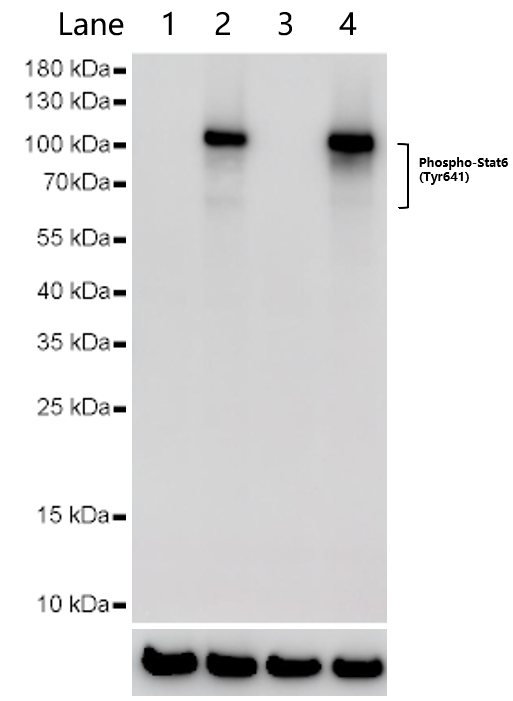
WB result of Phospho-Stat6 (Tyr641) Recombinant Rabbit mAb
Primary antibody: Phospho-Stat6 (Tyr641) Recombinant Rabbit mAb at 1/1000 dilution
Lane 1: PBMC+IL-4(50ng/mL, 6h) (-)
Lane 2: PBMC+IL-4(50ng/mL, 6h) (+) (UA040475)
Lane 3: PBMC+IL-4(50ng/mL, 6h) (-)
Lane 4: PBMC+IL-4(50ng/mL, 6h) (+ (Competitor P)
Secondary antibody: Goat Anti-rabbit IgG, (H+L), HRP conjugated at 1/10000 dilution
Predicted MW: 93 kDa
Observed MW: 75, 85, 105 kDa
生物活性
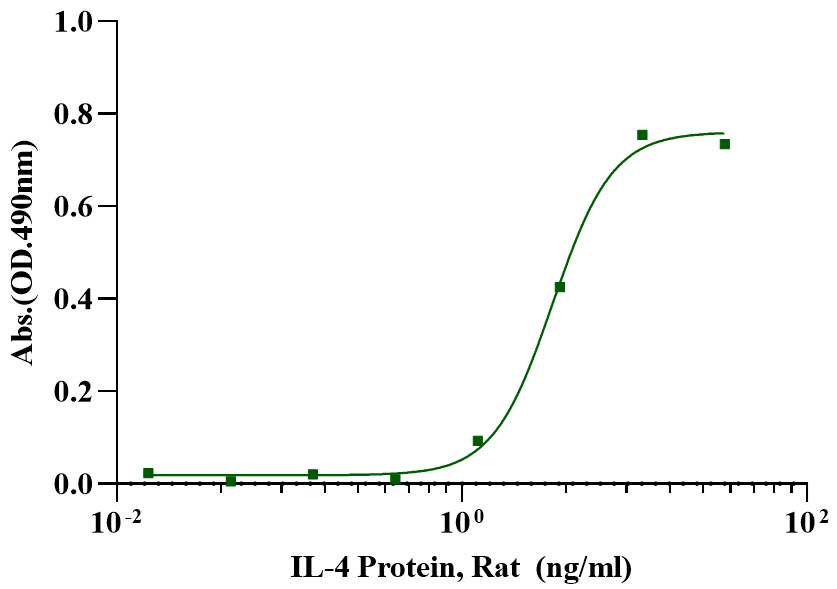
Measured in a cell proliferation assay using rat NB2-11 cell, the EC50 for this effect is 3.0-3.7 ng/mL.
电泳
2μg (R: reducing condition, N: non-reducing condition).
体积排阻色谱(SEC-HPLC)
>90% as determined by SEC-HPLC.

评论(0)