




 分享
分享产品介绍 评论(0)
物种
Porcine分子别名
Cachectin, TNF-alpha, Tumor necrosis factor ligand superfamily member 2Accession
P23563表达序列
Arg78-Leu232
表达宿主
E.coli分子量
17kDa
纯度
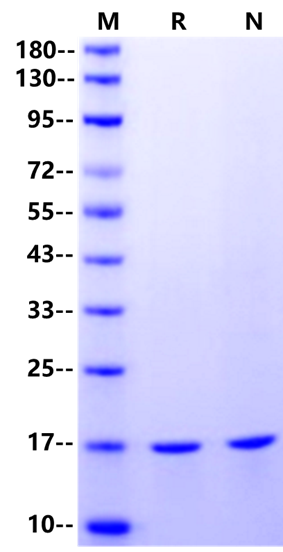
>95% by SDS-PAGE内毒素含量
<0.1EU/μg标记
Unconjugated标签
No Tag性状
Lyophilized Powder缓冲体系
PBS, pH7.4
溶解方法
Reconstitute at 0.1-1 mg/ml according to the size in ultrapure water after rapid centrifugation.
储存条件
· 12 months from date of receipt, lyophilized powder stored at -20 to -80℃.
· 3 months, -20 to -80℃ under sterile conditions after reconstitution.
· 1 week, 2 to 8℃ under sterile conditions after reconstitution.
· Please avoid repeated freeze-thaw cycles.
文献引用
1. Zelova, H. and J. Hosek (2013) Inflamm. Res. 62:641.
2. Juhasz, K. et al. (2013) Expert Rev. Clin. Immunol. 9:335.
3. Pauli, U. et al. (1989) Gene 81:185.
4. Tang, P. et al. (1996) Biochemistry 35:8216.
5. Perez, C. et al. (1990) Cell 63:251.
6. Black, R.A. et al. (1997) Nature 385:729.
7. Moss, M.L. et al. (1997) Nature 385:733.
8. Gearing, A.J.H. et al. (1994) Nature 370:555.
9. Schall, T.J. et al. (1990) Cell 61:361.
10. Loetscher, H. et al. (1990) Cell 61:351.
11. Dembic, Z. et al. (1990) Cytokine 2:231.
12. Smith, C.A. et al. (1990) Science 248:1019.
13. Loetscher, H. et al. (1991) J. Biol. Chem. 266:18324.
14. Pinckard, J.K. et al. (1997) J. Biol. Chem. 272:10784.
15. Engelmann, H. et al. (1990) J. Biol. Chem. 265:1531.
Tumor necrosis factor alpha (TNF-alpha), also known as cachectin and TNFSF2, is the prototypic ligand of the TNF superfamily. It is a pleiotropic molecule that plays a central role in inflammation, immune system development, apoptosis, and lipid metabolism. Porcine TNF-alpha consisits of a 35 amino acid (aa) cytoplasmic domain, a 21 aa transmembrane segment, and a 176 aa extracellular domain (ECD). Within the ECD, porcine TNF-alpha shares 69%-86% aa sequence identity with bovine, canine, cotton rat, equine, feline, human, mouse, rat, and rhesus TNF-alpha . TNF-alpha is produced by a wide variety of immune, epithelial, endothelial, and tumor cells. TNF-alpha is assembled intracellularly to form a noncovalently linked homotrimer which is expressed on the cell surface. Cell surface TNF-alpha can induce the lysis of neighboring tumor cells and virus infected cells, and it can generate its own downstream cell signaling following ligation by soluble TNFR I. Shedding of membrane bound TNF-alpha by TACE/ADAM17 releases the bioactive cytokine, a 55 kDa soluble trimer of the TNF-alpha extracellular domain. TNF-alpha binds the ubiquitous 55-60 kDa TNF RI and the hematopoietic cell-restricted 80 kDa TNF RII, both of which are also expressed as homotrimers. Both type I and type II receptors bind TNF-alpha with comparable affinity, although only TNF RI contains a cytoplasmic death domain which triggers the activation of apoptosis. Soluble forms of both types of receptors are released and can neutralize the biological activity of TNF-alpha.
生物活性
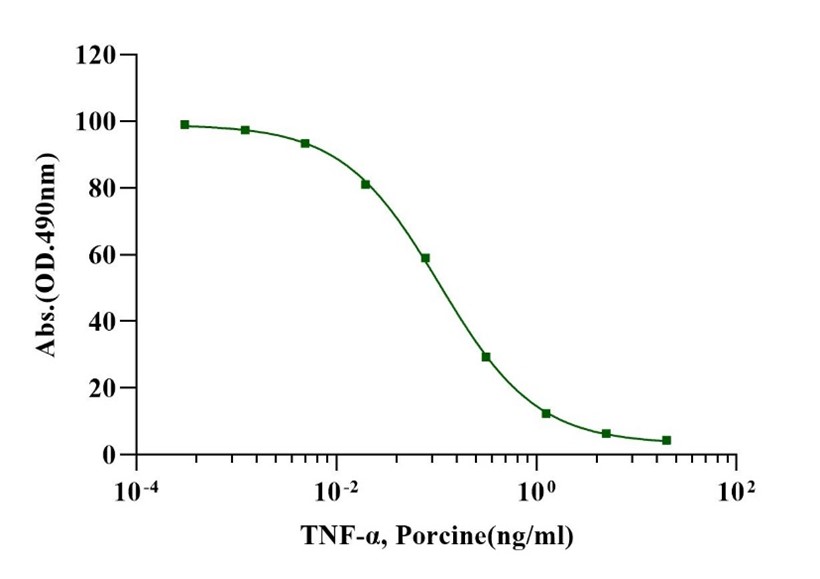
Measured in a cytotoxicity assay using L-929 mouse fibrosarcoma cells in the presence of the metabolic inhibitor actinomycin D, the EC50 for this effect is less than 0.1ng/ml.
电泳
1μg (R: reducing condition, N: non-reducing condition).

评论(0)