




 分享
分享产品介绍 评论(0)
物种
Human分子别名
C7,crg-2,gIP-10,IFI10,INP10,IP-10,mob-1,SCYB10,CXCL10Accession
P02778表达序列
Val22-Pro98表达宿主
E.coli分子量
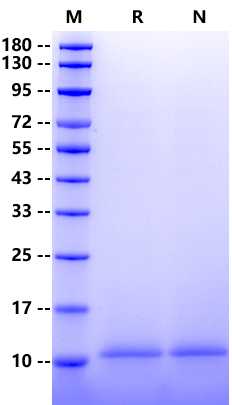
10-11kDa纯度
>95% by SDS-PAGE内毒素含量
<1EU/μg标记
Unconjugated标签
No Tag性状
Lyophilized Powder缓冲体系
20mM Tris, 500mM NaCl, 1mM TCEP, pH8.0溶解方法
Reconstitute at 0.1-1 mg/ml according to the size in ultrapure water after rapid centrifugation.储存条件
· 12 months from date of receipt, lyophilized powder stored at -20 to -80℃.
· 3 months, -20 to -80℃ under sterile conditions after reconstitution.
· 1 week, 2 to 8℃ under sterile conditions after reconstitution.
· Please avoid repeated freeze-thaw cycles.文献引用
1、Swaminathan G J. et al. (2003) Crystal structures of oligomeric forms of the IP-10/CXCL10 chemokine. Structure. 11(5): 521-532.
2、Booth V. et al. (2002) The CXCR3 binding chemokine IP-10/CXCL10: structure and receptor interactions. Biochemistry. 41(33): 10418-10425.
IP-10 (Interferon gamma-induced protein 10 or CXCL10) is a proinflammatory cytokine that is secreted by various cell types in response to stimuli such as IFN-γ and LPS. It binds to CXCR3 receptor and regulates chemotaxis, apoptosis, growth, and angiostasis of immune cells. IP-10 is involved in the pathogenesis of many inflammatory disorders, such as autoimmune diseases, HIV infection, and tumour growth. CXCL10 is the chemokine released in highest quantities by islets immediately following islet perfusion in the transplant procedure, as identified by serum samples from 34 patients undergoing islet transplantion. Inflammatory mediators such as physical and chemical stress by isolation and infusion procedures stimulate the release of CXCL10 through an NFAT-MAPK signaling pathway. In particular, interferon-γ release at high concentrations during islet infusion contributes to the stimulation of CXCL10 and the loss of up to 50% of the islet graft immediately following transplant.
电泳
- 1μg (R: reducing condition, N: non-reducing condition).

评论(0)