




 分享
分享产品介绍 评论(0)
物种
Human papillomavirus type 16分子别名
HPV 16 E7Accession
P03129表达序列
Protein sequence (P03129, Met1-Pro98)
MHGDTPTLHEYMLDLQPETTDLYCYEQLNDSSEEEDEIDGPAGQAEPDRAHYNIVTFCCKCDSTLRLCVQSTHVDIRTLEDLLMGTLGIVCPICSQKP表达宿主
E.coli分子量
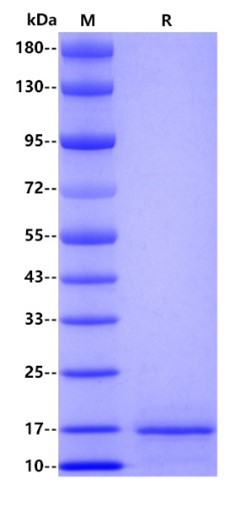
Predicted MW: 11.0 kDa Observed MW: 17 kDa
纯度
>95% by SDS-PAGE
标记
Unconjugated标签
No Tag性状
Lyophilized Powder缓冲体系
0.2M PBS, pH7.4溶解方法
Reconstitute no more than 1 mg/mL according to the size in deionized water after rapid centrifugation.
储存条件
· 12 months from date of receipt, lyophilized powder stored at -20 to -80℃.
· 3 months, -20 to -80℃ under sterile conditions after reconstitution.
· 1 week, 2 to 8℃ under sterile conditions after reconstitution.
· Please avoid repeated freeze-thaw cycles.
Human papilloma viruses (HPVs) can be classified as either high-risk or low-risk according to their association with cancer. HPV16 and HPV18 are the most common of the high-risk group while HPV6 and HPV11 are among the low-risk types. Approximately 90% of cervical cancers contain HPV DNA of the high-risk types. Mutational analysis have shown that the E6 and E7 genes of the high-risk HPVs are necessary and sufficient for HPV transforming function. The specific interactions of the E6 and E7 proteins with p53 and pRB, respectively, correlate with HPV high and low risk classifications. The high-risk HPV E7 proteins bind to pRB with a higher affinity than do the low-risk HPV proteins. Human papillomavirus (HPV) E7 plays a major role in HPV-induced malignancy, perturbing cell cycle regulation, and driving cell proliferation. Major targets of cancer-causing HPV E7 proteins are the pRB family of tumor suppressors, which E7 targets for proteasome-mediated degradation and whose interaction is promoted through an acidic patch, downstream of the LXCXE motif in E7, that is subject to phosphorylation by casein kinase II (CKII).
电泳
2 μg(R: reducing conditions)

评论(0)