




 分享
分享产品介绍 评论(0)
物种
HumanAccession
P05413表达序列
MHHHHHHVDAFLGTWKLVDSKNFDDYMKSLGVGFATRQVASMTKPTTIIEKNGDILTLKTHSTFKNTEISFKLGVEFDETTADDRKVKSIVTLDGGKLVHLQKWDGQETTLVRELIDGKLILTLTHGTAVCTRTYEKEA表达宿主
E.coli分子量
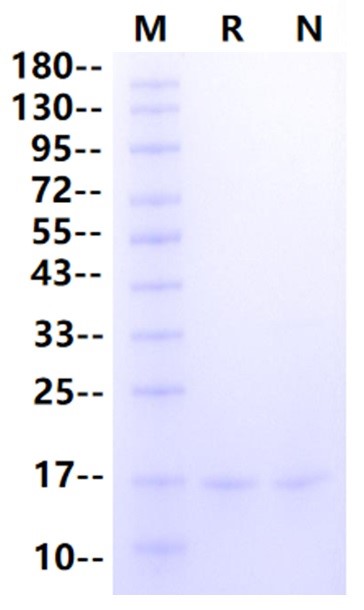
15.7 kDa(Reducing)纯度
>95%, by SDS-PAGE under reducing conditions
内毒素含量
<2EU/μg标记
Unconjugated标签
His Tag性状
Lyophilized Powder缓冲体系
PBS, pH7.4溶解方法
Reconstitute at less than 1 mg/mL according to the size in ultrapure water after rapid centrifugation.储存条件
· 12 months from date of receipt, lyophilized powder stored at -20 to -80℃.
· 3 months, -20 to -80℃ under sterile conditions after reconstitution.
· 1 week, 2 to 8℃ under sterile conditions after reconstitution.
· Please avoid repeated freeze-thaw cycles.
Fatty acid-binding protein 3 (FABP3) is a cytosolic protein found in various tissues, including heart, skeletal muscle, intestinal mucosa, liver, and kidney. It is also highly expressed in the adult brain, particularly in the pons, frontal lobe, and hippocampus. In the brain, FABP3 regulates the lipid composition of the membrane and transports fatty acids between different intracellular compartments. It is released extracellularly after neuronal damage and high cerebrospinal fluid (CSF) concentration of FABP3 is found in acute conditions, such as brain injury and stroke. CSF FABP3 concentration is also higher in conditions with neuro degeneration/neuronal damage, e.g., Alzheimer’s disease (AD), mild cognitive impairment (MCI) due to AD, dementia with Lewy bodies, and Creutzfeldt–Jakob disease. CSF FABP3 concentration correlates with cognitive decline and are associated with brain volume loss in areas selectively affected in early AD. Thus, FABP3 is suggested to be a general marker of neuronal damage.
电泳
- FABP3 His Tag, Human,1μg(R: reducing conditions, N: non-reducing conditions).

评论(0)