




 分享
分享产品介绍 评论(0)
物种
Human抗原名称
Renin分子别名
REN, FLJ10761, Renin, angiotensinogenaseAccession
P00797表达序列
Leu24-Arg406 (R66K), with C-terminal 8*His表达宿主
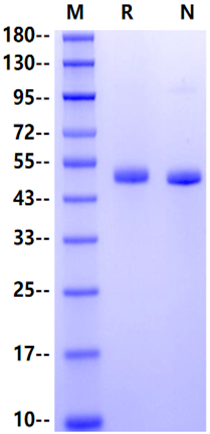
HEK293分子量
45-50kDa纯度
>95% by SDS-PAGE内毒素含量
<0.1EU/μg标记
Unconjugated标签
His Tag性状
Lyophilized Powder缓冲体系
PBS, pH7.4溶解方法
Reconstitute at 0.1-1 mg/ml according to the size in ultrapure water after rapid centrifugation.储存条件
· 12 months from date of receipt, lyophilized powder stored at -20 to -80℃.
· 3 months, -20 to -80℃ under sterile conditions after reconstitution.
· 1 week, 2 to 8℃ under sterile conditions after reconstitution.
· Please avoid repeated freeze-thaw cycles.文献引用
1. Yokosawa, H. et al. (1980) J. Biol. Chem. 255:3498. 2. Fuminaki, S. et al. (2004) in Handbook of Proteolytic Enzymes, Barret, A. J. et al. eds. p. 54.
Human Renin is a member of the aspartyl proteinase family produced largely in part by the juxtaglomerular cells in the kidney. Renin is also known as REN and angiotensinogenase, is a circulating enzyme that participates in the body's renin-angiotensin system (RAS), and plays an essential role in the elevation of arterial blood pressure and increased sodium retention by the kidney. Renin activates the renin-angiotensin system by cleaving angiotensinogen, produced by the liver, to yield angiotensin I, which is further converted into angiotensin II by ACE, the angiotensin-converting enzyme primarily within the capillaries of the lungs. Renin is secreted from kidney cells, which are activated via signaling from the macula densa, which responds to the rate of fluid flow through the distal tubule, by decreases in renal perfusion pressure (through stretch receptors in the vascular wall), and by sympathetic nervous stimulation, mainly through beta-1 receptor activation. Renin can bind to ATP6AP2, which results in a fourfold increase in the conversion of angiotensinogen to angiotensin I over that shown by soluble renin. In addition, renin binding results in phosphorylation of serine and tyrosine residues of ATP6AP2. The level of renin mRNA appears to be modulated by the binding of HADHB, HuR and CP1 to a regulatory region in the 3' UTR. An over-active renin-angiotension system leads to vasoconstriction and retention of sodium and water. These effects lead to hypertension. Therefore, renin inhibitors can be used for the treatment of hypertension. Renin differs from the other members of this class by having a pH optimum near the neutral pH region with native substrates instead of a pH 2.0 to 3.4 range.
电泳
1μg (R: reducing condition, N: non-reducing condition).

评论(0)