




 分享
分享产品介绍 评论(0)
物种
Mouse抗原名称
VTN/Vitronectin分子别名
VN,S-protein,Serum-spreading factorAccession
P29788表达序列
Asp20-Lys478, with C-terminal 8*His表达宿主
HEK293分子量
70-72kDa纯度
>95% by SDS-PAGE内毒素含量
<0.1EU/μg标记
Unconjugated标签
His Tag性状
Lyophilized Powder缓冲体系
PBS, pH7.4溶解方法
Reconstitute at 0.1-1 mg/ml according to the size in ultrapure water after rapid centrifugation.储存条件
· 12 months from date of receipt, lyophilized powder stored at -20 to -80℃.
· 3 months, -20 to -80℃ under sterile conditions after reconstitution.
· 1 week, 2 to 8℃ under sterile conditions after reconstitution.
· Please avoid repeated freeze-thaw cycles.文献引用
1. Schvartz, I., Seger, D., and Shaltiel, S. (1999) Vitronectin. Int. J. Biochem. Cell Biol. 31, 539- 544.
Vitronectin (VTN), a multifunctional glycoprotein with various physiological functions, exists in plasma and the extracellular matrix. The human VTN monomer is synthesised as a precursor polypeptide of 478 amino acids (aas) (75 kDa) including a 19-amino acid signal peptide. Vitronectin is enriched in CNS pericytes, and mice lacking vitronectin as well as vitronectin mutant mice (VtnRGE) that cannot bind integrin receptors exhibit barrier leakage. Vitronectin regulates barrier function via binding to its integrin receptors on endothelial cells. It is known to be involved in the cell attachment, spreading and migration through binding to the integrin receptor, mainly via the RGD sequence. Recent evidence shows more functions of VTN in the nervous system as it participates in neural differentiation, neuronutrition and neurogenesis, as well as in regulating axon size, supporting and guiding neurite extension. Furthermore, VTN was proved to play a key role in protecting the brain as it can reduce the permeability of the blood-brain barrier by interacting with integrin receptors in vascular endothelial cells.
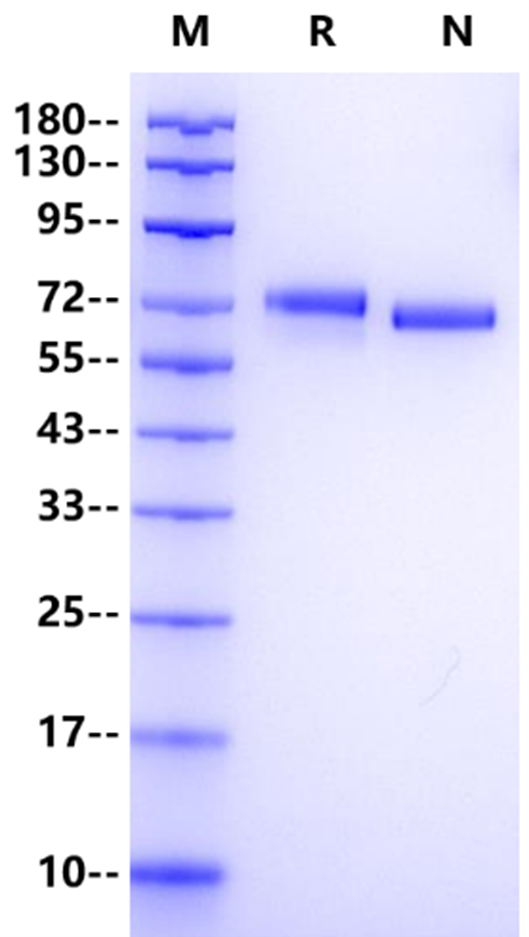
电泳
1μg (R: reducing conditions, N: non-reducing conditions).

评论(0)