




 分享
分享产品介绍 评论(0)
物种
Cynomolgus抗原名称
C3分子别名
AHUS5, ARMD9, ASP, C3a, C3b, CPAMD1, HEL-S-62pAccession
G7PYU9-1表达序列
Thr23-Asn1663, with C-terminal 10* His表达宿主
HEK293分子量
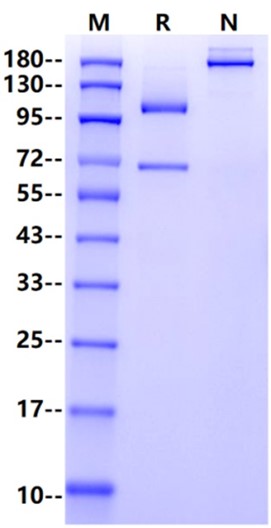
70, 110 & 160kDa纯度
>95% by SDS-PAGE内毒素含量
<0.1EU/μg标记
Unconjugated标签
His Tag性状
Lyophilized Powder缓冲体系
PBS, pH7.4溶解方法
Reconstitute at 0.1-1 mg/ml according to the size in ultrapure water after rapid centrifugation.储存条件
· 12 months from date of receipt, lyophilized powder stored at -20 to -80℃.
· 3 months, -20 to -80℃ under sterile conditions after reconstitution.
· 1 week, 2 to 8℃ under sterile conditions after reconstitution.
· Please avoid repeated freeze-thaw cycles.文献引用
1.Lubbers R. et al. (2017) Production of complement components by cells of the immune system. Clin Exp Immunol. 188: 183-194.2.King B C. et al. (2019) Intracellular cytosolic complement component C3 regulates cytoprotective autophagy in pancreatic beta cells by interaction with ATG16L1. Autophagy. 15: 919-921.3.Hajishengallis G. et al. (2017) Novel mechanisms and functions of complement. Nat Immunol. 18: 1288-1298.4.Ursini F. et al. (2018) The emerging role of complement C3 as a biomarker of insulin resistance and cardiometabolic diseases: preclinical and clinical evidence. Rev Recent Clin Trials. 13: 61-68.
As the most abundant complement protein in the blood, complement component 3 (C3) is a key player in the complement system and a vital factor in the innate immune system. The human C3 gene (C3) is located on the short arm of chromosome 19 (19p13.3), contains 41 exons, and is highly polymorphic, suggesting that selection of C3 alleles within a population may confer differences in immune responses to various pathogens. Circulating C3 is produced primarily in the liver; however, some immune cells and non-immune cells, such as lymphocytes, neutrophils and mesenchymal cells, can also synthesize C3. C3 can be activated tonically in human CD4+ T cells through cathepsin L cleavage into C3a and C3b. C3 is highly expressed in isolated human islets, and C3-knockout β-cells exhibit increased cell death after challenge with diabetogenic stresses. Other studies have indicated that intracellular C3 protects rodent and human pancreatic β-cells from cytokine-induced apoptosis. The close correlations between complement C3 levels and obesity/IR have been reported in some researches. C3 could be an early biomarker for incident T2DM, and that BMI might play a potential mediating role in the C3-T2DM associations, which provided clues for the pathogenesis of diabetes. C3 could independently predict the development of diabetes mellitus, pre-diabetes and metabolic syndrome.
电泳
- 1μg (R: reducing conditions, N: non-reducing conditions).

评论(0)