




 分享
分享产品介绍 评论(0)
物种
Human抗原名称
OPN/SPP1分子别名
BNSP,BSP-1Accession
P10451-5表达序列
Ile17-Asn300, with C-terminal 8*His表达宿主
HEK293分子量
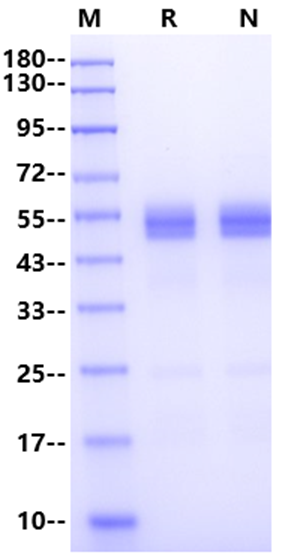
45-55kDa (Reducing)
纯度
>95% by SDS-PAGE
内毒素含量
<0.1EU/μg标记
Unconjugated标签
His Tag性状
Lyophilized Powder缓冲体系
PBS, pH7.4溶解方法
Reconstitute at 0.1-1 mg/ml according to the size in ultrapure water after rapid centrifugation.储存条件
· 12 months from date of receipt, lyophilized powder stored at -20 to -80℃.
· 3 months, -20 to -80℃ under sterile conditions after reconstitution.
· 1 week, 2 to 8℃ under sterile conditions after reconstitution.
· Please avoid repeated freeze-thaw cycles.文献引用
1. Kung-Hao Liang. OPN sesame. Hepatobiliary Surg Nutr 2014;3(3):112-114.
OPN is an integrin-binding glycoprotein also known as secreted phosphoprotein 1 (SPP1). OPN is so named because it was first discovered in osteoblasts and osteoclasts. The latter is developed from the macrophage lineage. OPN protein has a secreted form and an intracellular form. The secreted OPN has two integrin-binding domains which can adhere to integrins on the surfaces of macrophages, making it a potent chemoattractant as well as an activator of macrophages. In innate immunological cells such as dendritic cells, OPN can be activated upon infection. The OPN-integrin binding can trigger downstream macrophage activities including TNF secretion, producing an inflammatory microenvironment. Poor prognosis of HCC was correlated with elevated OPN RNA, tissue OPN protein levels and pre-operative serum OPN protein levels. An anti-OPN antibody has been shown to defer the growth and metastasis of breast cancer in a mice model. As macrophages can also secret OPN, PTM and OPN form a vicious autocrine/paracrine cycle for the progression of cancer. Thus, in the future, novel strategies to break this cycle could bring to new anti-HCC treatments.
电泳
- 1μg (R: reducing condition, N: non-reducing condition).

评论(0)