


所有图片(1/1)


 分享
分享产品介绍 评论(0)
产品规格
物种
Human分子别名
ATG4B,APG4B,AUTL1,AUT like 1 cysteine endopeptidase,Cysteine protease ATG4B,MGC1353Accession
Q9Y4P1表达序列
Met1-Leu393, with N-terminal 8*His表达宿主
E.coli分子量
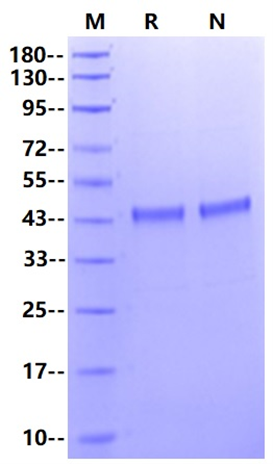
45kDa纯度
>95% by SDS-PAGE & RP-HPLC内毒素含量
<1EU/μg标记
HRP标签
His Tag性状
Lyophilized Powder缓冲体系
PBS, pH7.4溶解方法
Reconstitute at 0.1-1 mg/ml according to the size in ultrapure water after rapid centrifugation.储存条件
· 12 months from date of receipt, lyophilized powder stored at -20 to -80℃.
· 3 months, -20 to -80℃ under sterile conditions after reconstitution.
· 1 week, 2 to 8℃ under sterile conditions after reconstitution.
· Please avoid repeated freeze-thaw cycles.文献引用
1、Zheng X. et al. (2020) The protease activity of human ATG4B is regulated by reversible oxidative modification. Autophagy. 16(10): 1838-1850.
背景介绍
- Initiation and development of autophagy is modulated by several autophagy-related (ATG) genes, which have been identified in yeast and human. Autophagy begins with the formation and maturation of the double-membraned autophagosomes which engulf and deliver cargoes to lysosomes for degradation. The assembling process of autophagosomes is mediated by a family of core ATG proteins, including two ubiquitin-like systems. First, inactive precursor MAP1LC3/LC3 is cleaved by protease ATG4B at the conserved C-terminal glycine residue. After a set of transfer and activation by ATG7, ATG3 and ATG12-ATG5-ATG16L1, the processed LC3 (LC3-I) finally conjugates with phosphatidylethanolamine (PE) at the exposed glycine site via a covalent bond. So far, lipidated LC3, called LC3-II, has become a biomarker of autophagy because of its characteristic of anchoring into the autophagosome membrane. Upon fusion with lysosomes, ATG4B can, in turn, deconjugate LC3-PE to release LC3-I to the cytoplasm for reuse. Hence, ATG4B serves as a priming and delipidation enzyme whose fine regulation is essential for autophagy process.
电泳
- 2μg (R: reducing conditions, N: non-reducing conditions).

评论(0)