





 分享
分享产品介绍 评论(0)
物种
Human分子别名
TNFRSF8,CD30,D1S166E,Ki-1Accession
P28908表达序列
Phe19-Lys379, with C-terminal 8* His
表达宿主
HEK293分子量
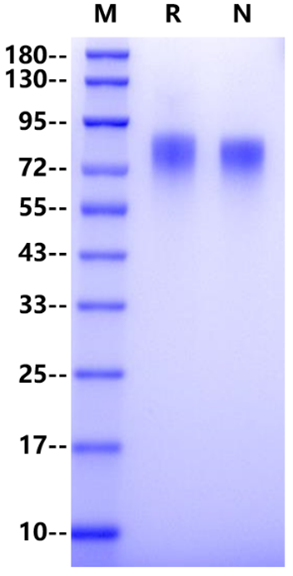
72-89kDa
纯度
>95% by SDS-PAGE内毒素含量
<0.1EU/μg标记
Unconjugated标签
His Tag性状
Lyophilized Powder缓冲体系
PBS, pH7.4
溶解方法
Reconstitute at 0.1-1 mg/ml according to the size in ultrapure water after rapid centrifugation.
储存条件
· 12 months from date of receipt, lyophilized powder stored at -20 to -80℃.
· 3 months, -20 to -80℃ under sterile conditions after reconstitution.
· 1 week, 2 to 8℃ under sterile conditions after reconstitution.
· Please avoid repeated freeze-thaw cycles.
文献引用
1、Feghali-Bostwick C A. et al. (2008) Autoantibodies in patients with chronic obstructive pulmonary disease. American Journal of Respiratory and Critical Care Medicine. 177(2): 156-163.
2、Wang G N. et al. (2017) Prognostic significance of CD30 expression in nasal natural killer/T-cell lymphoma. Oncology Letters. 13(3): 1211-1215.
3、Horie R. et al. (1998) A novel domain in the CD30 cytoplasmic tail mediates NFκB activation. International Immunology. 10(2): 203-210.
4、Xu M L. et al. (2020) Practical approaches on CD30 detection and reporting in lymphoma diagnosis. Am J Surg Pathol. 44(2): 1-14.
CD30, a member of the tumor necrosis factor receptor superfamily, also known as Ki-1, is a kind of type I transmembrane glycoprotein. The CD30 protein is composed of 595 amino acids, and the cytosolic and transmembrane region in the protein are composed of 188 amino acids and 24 amino acids, respectively. The extracellular region is the leading peptide of 18 amino acids, followed by 365 amino acids. CD30 is widely expressed in viral-infected lymphocytes and lymphoma cells and activated T cells. Moreover, CD30 is also expressed in alveolar macrophages, epidermal cells, activated NK cells, decidual cells, resting B cells, granulocytes, thymocytes, and medulla cells. The bind of CD30 and CD30L induces the production of cytokine, which promotes cell proliferation, differentiation, cell growth, stagnation, and death. Binding of CD30 with its receptor ligand activates TNF receptor-associated factor (TRAF)2 and TRAF5, initiating signal transduction pathways that can lead either to proliferation or apoptosis. CD30 induced apoptosis may lead to the self-regression seen in lymphomatoid papulosis lesions, whereas proliferation may result in anaplastic large-cell lymphoma (ALCL). CD30 ligation leads to nuclear factor-kappa B (NFκB) and/or mitogen-activated protein kinase (MAPK) pathways, ultimately leading to survival of neoplastic cells. CD30 can serve both as a diagnostic marker for lymphocyte malignancies and as a target for therapy.
流式分析
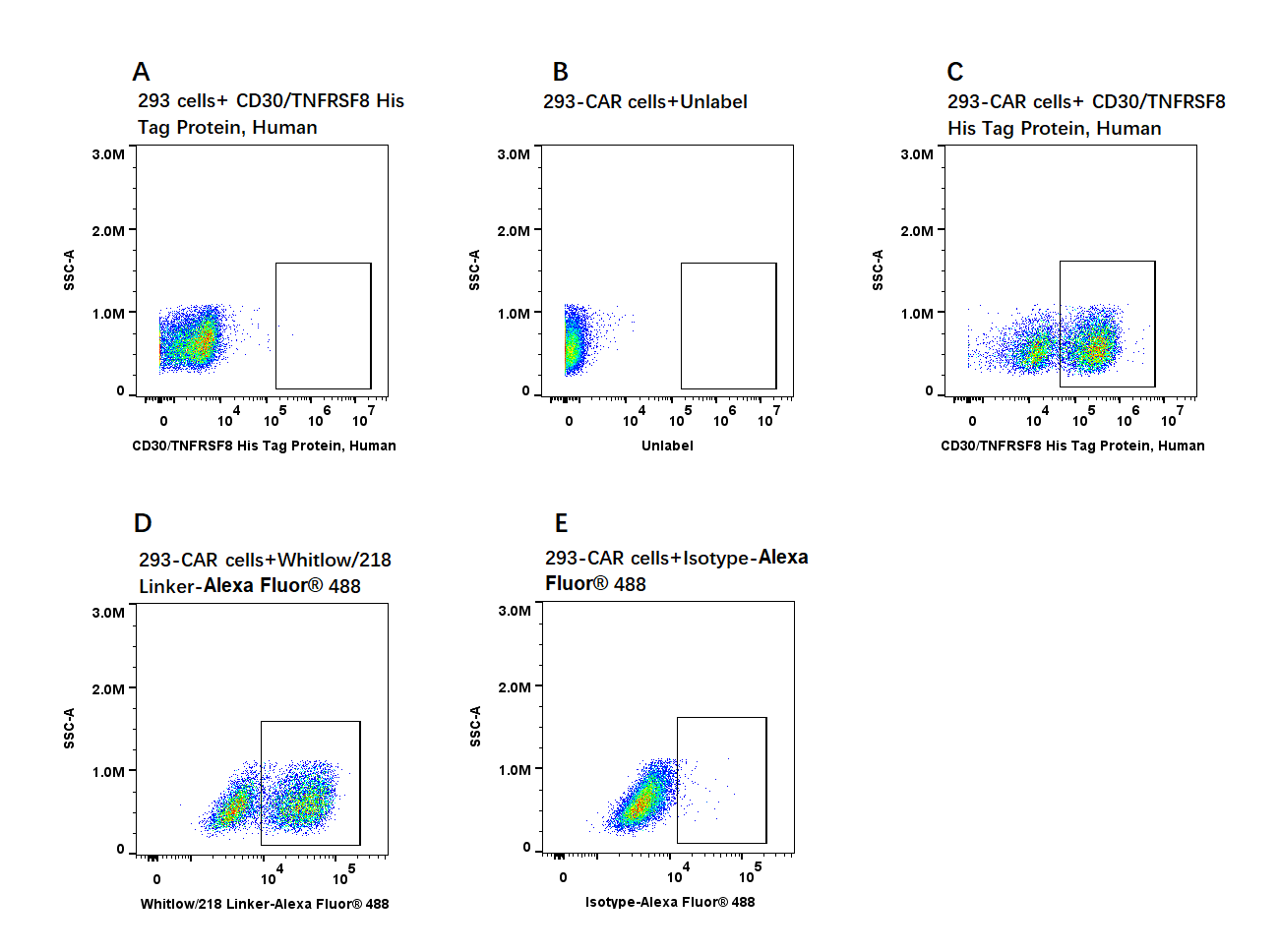
2e5 of transient transfected anti-CD30/TNFRSF8 ScFv CAR-293 cells were stained with 0.01ug CD30/TNFRSF8 His Tag Protein, Human, (Cat. No. UA010362) and unlable respectively (Fig. C and B), and non-transfected 293 cells were used as a control (Fig. A). Alexa Fluor 647 signal was used to evaluate the binding activity. 2e5 of transient transfected anti- CD30/TNFRSF8 ScFv CAR-293 cells were stained with isotype and Whitlow/218 Linker-Alexa Fluor® 488 (Fig. D and E). Alexa Fluor® 488 signal was used to evaluate the binding activity.
电泳
- 1μg (R: reducing conditions, N: non-reducing conditions).
ELISA
Immobilized CD30/TNFRSF8 His Tag, Human (Cat. No. UA010362) at 2μg/mL (100μL/well) can bind Anti-Human CD30 Monoclonal Antibody with EC50 of 4.66-6.44ng/ml.
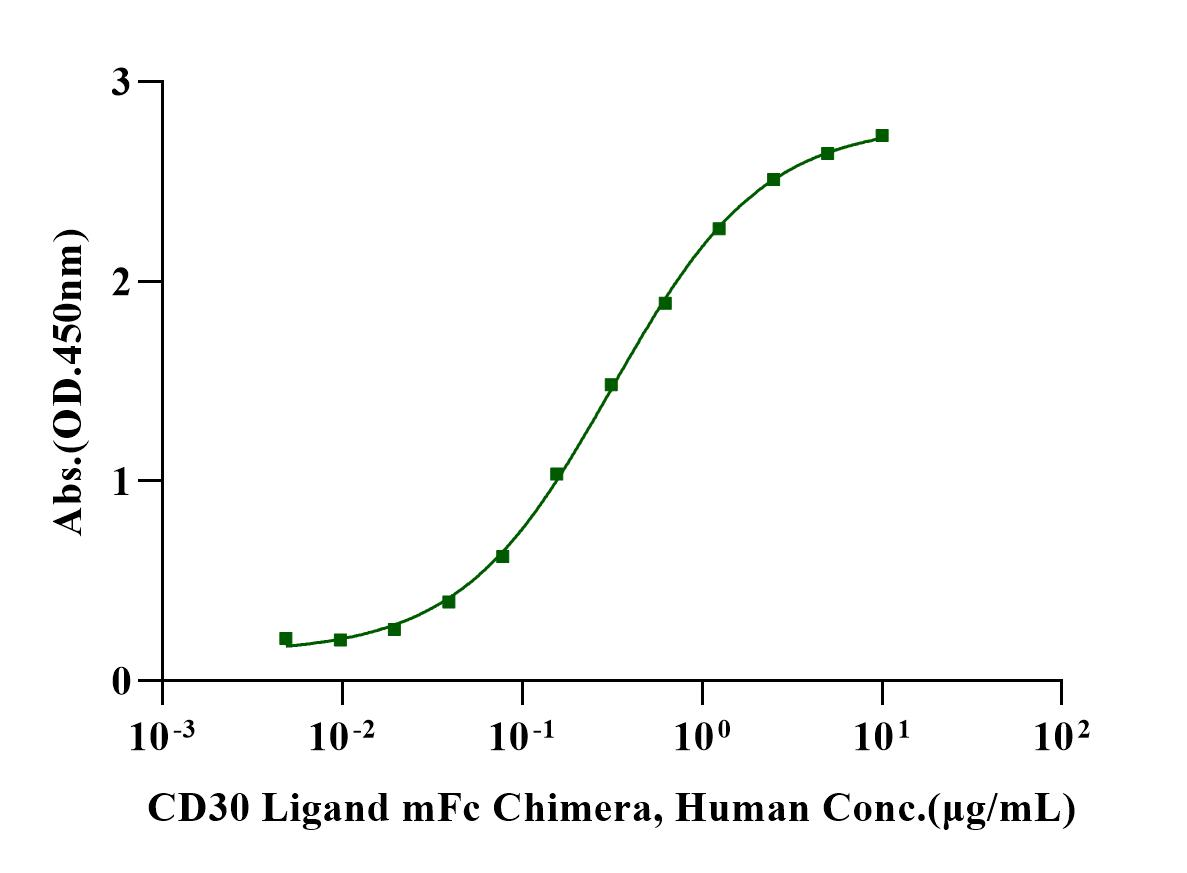
Immobilized CD30/TNFRSF8 His Tag Protein, Human (Cat. No. UA010362) at 2μg/mL (100μL/well) can bind CD30 Ligand mFc Chimera Protein, Human (Cat. No. UA010378) with EC50 of 0.29-0.34μg/ml.

评论(0)