




 分享
分享产品介绍 评论(0)
物种
Cynomolgus分子别名
TROP1,EpCAM,TACSTD1,CD326,DIAR5,EGP2,EGP314,EGP40,ESA,GA733-2,HNPCC8,KS1/4,KSA,M4S1,MIC18,MK1Accession
Q1WER1表达序列
Gln24-Lys265, with C-terminal His表达宿主
HEK293分子量
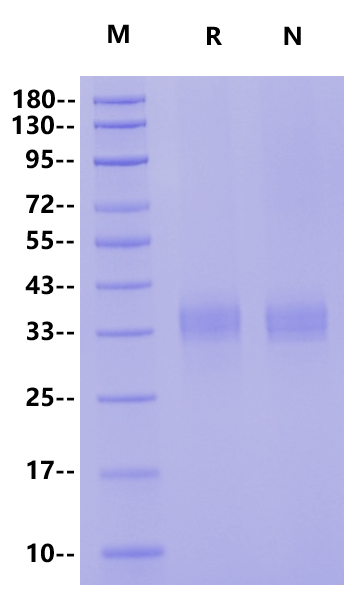
30-40kDa
纯度
>95% by SDS-PAGE内毒素含量
<0.1EU/μg标记
Unconjugated标签
His Tag性状
Lyophilized Powder缓冲体系
PBS, pH7.4溶解方法
Reconstitute at 0.1-1 mg/ml according to the size in ultrapure water after rapid centrifugation.
储存条件
· 12 months from date of receipt, lyophilized powder stored at -20 to -80℃.
· 3 months, -20 to -80℃ under sterile conditions after reconstitution.
· 1 week, 2 to 8℃ under sterile conditions after reconstitution.
· Please avoid repeated freeze-thaw cycles.文献引用
1、Gires O. et al. (2020) Expression and function of epithelial cell adhesion molecule EpCAM: Where are we after 40 years? Cancer Metastasis Rev. 39: 969-987.
2、Fagotto F. et al. (2020) EpCAM cellular functions in adhesion and migration, and potential impact on invasion: A critical review. Biochim. Biophys. Acta Rev. Cancer. 1874: 188436.
Epithelial Cellular Adhesion Molecule (EpCAM), also known as KS1/4, gp40, GA733-2, 17-1A, and TROP-1, is a 40 kDa transmembrane glycoprotein. Based on its similarity with human EpCAM, cynomolgus/rhesus EpCAM is predicted to consist of a 242 amino acid (aa) extracellular domain with two epidermal growth factor like (EGF like) repeats within the cysteine rich N terminal region, a 23 aa transmembrane domain, and a 26 aa cytoplasmic domain. Owing to its frequent and high expression on carcinomas and their metastases, EpCAM serves as a prognostic marker, a therapeutic target, and an anchor molecule on circulating and disseminated tumor cells (CTCs/DTCs), which are considered the major source for metastatic cancer cells. Today, EpCAM is reckoned as a multi-functional transmembrane protein involved in the regulation of cell adhesion, proliferation, migration, stemness, and epithelial-to-mesenchymal transition (EMT) of carcinoma cells. To fulfill these functions, EpCAM is instrumental in intra- and intercellular signaling as a full-length molecule and following regulated intramembrane proteolysis, generating functionally active extra- and intracellular fragments. Intact EpCAM and its proteolytic fragments interact with claudins, CD44, E-cadherin, epidermal growth factor receptor (EGFR), and intracellular signaling components of the WNT and Ras/Raf pathways, respectively. This plethora of functions contributes to shaping intratumor heterogeneity and partial EMT, which are major determinants of the clinical outcome of carcinoma patients. EpCAM represents a marker for the epithelial status of primary and systemic tumor cells and emerges as a measure for the metastatic capacity of CTCs. Consequentially, EpCAM has reclaimed potential as a prognostic marker and target on primary and systemic tumor cells.
电泳
- 1μg (R: reducing condition, N: non-reducing condition).
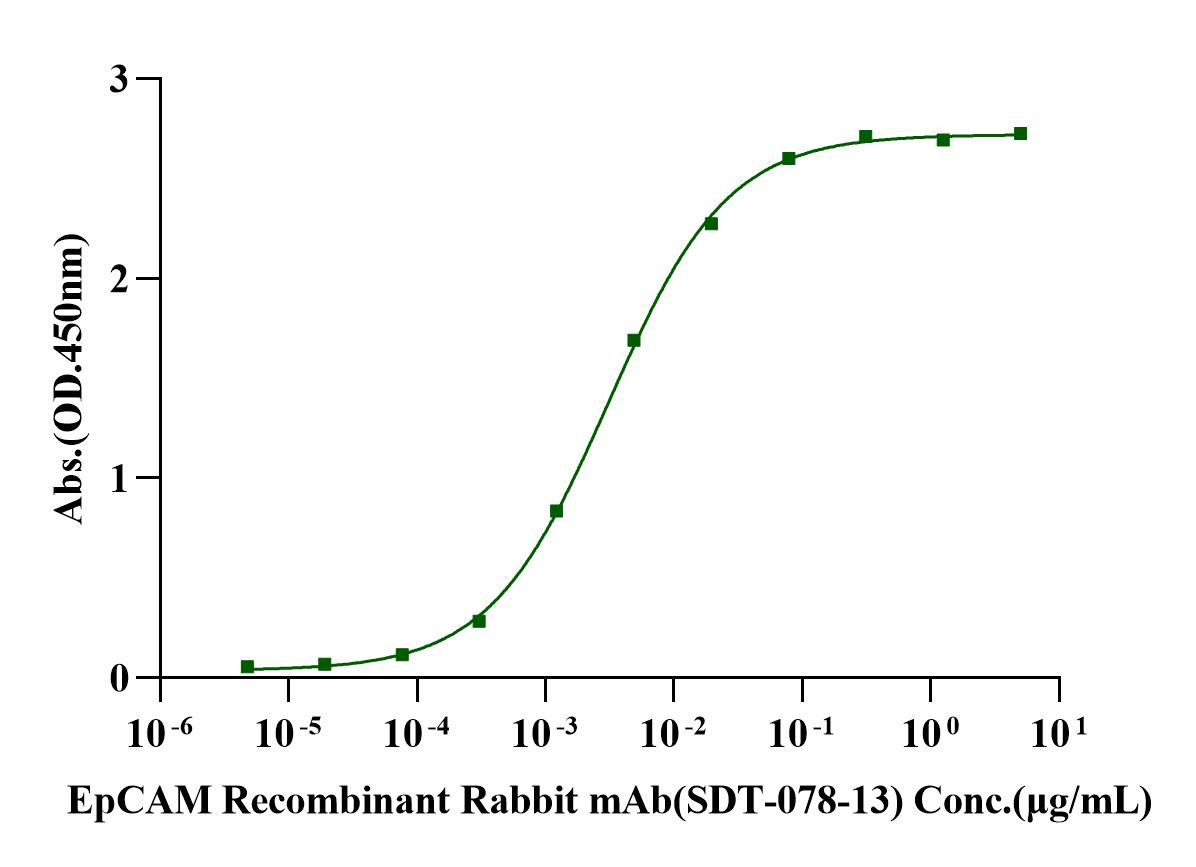
ELISA
Immobilized TROP1/EpCAM His Tag Protein, Cynomolgus (Cat. No. UA010257) at 2.0μg/mL (100μL/well) can bind EpCAM Recombinant Rabbit mAb(SDT-078-13) (Cat. No. S0B2028) with EC50 of 2.82-3.38ng/mL.

评论(0)