




 分享
分享产品介绍 评论(0)
物种
Cynomolgus分子别名
FGL1,Hepassocin,HP-041,HFREP-1,LFIRE-1Accession
G7N0K6表达序列
Leu23-Ile312, with N-terminal Human IgG1 Fc表达宿主
HEK293分子量
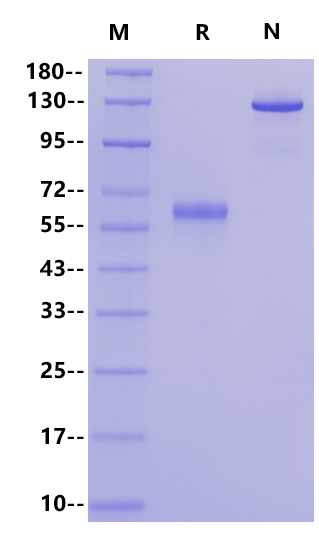
58-70kDa纯度
>95% by SDS-PAGE内毒素含量
<0.1EU/μg标记
Unconjugated标签
Human Fc Tag性状
Lyophilized Powder缓冲体系
PBS, pH7.4溶解方法
Reconstitute at 0.1-1 mg/ml according to the size in ultrapure water after rapid centrifugation.储存条件
· 12 months from date of receipt, lyophilized powder stored at -20 to -80℃.
· 3 months, -20 to -80℃ under sterile conditions after reconstitution.
· 1 week, 2 to 8℃ under sterile conditions after reconstitution.
· Please avoid repeated freeze-thaw cycles.文献引用
1、Wang J. et al. (2019) Fibrinogen-like protein 1 is a major immune inhibitory ligand of LAG-3. Cell. 176: 334–347.
2、Wu H T. et al. (2016) A novel hepatokine, HFREP1, plays a crucial role in the development of insulin resistance and type 2 diabetes. Diabetologia. 59: 1732–1742.
3、Demchev V. et al. (2013) Targeted deletion of fibrinogen like protein 1 reveals a novel role in energy substrate utilization. PLoS ONE. 8: e58084.
Hepassocin, also known as Hepatocyte-derived fibrinogen-related protein 1 (HFREP-1) and Fibrinogen-Like Protein 1 (FGL1), is a liver-specific secreted protein belonging to the fibrinogen superfamily whose members share a fibrinogen domain at their C-termini. FGL1 is a 68-KD protein comprised of a disulfide bond-linked homodimer. Its carboxyl terminus contains the β and γ subunits, which are highly homologous to fibrinogen but irrelevant to coagulation-related binding sites. Under normal physiological conditions, FGL1 is secreted mainly by hepatocytes in the liver (some of which may also exist in the pancreas). It is now clear that FGL1 is the product of hepatocyte regeneration and participates in hepatocyte mitosis and liver energy utilization (including lipid metabolism and blood glucose regulation). Apart from the above functions, FGL1 can also be detected in the plasma as an acute reactant, implying that FGL1 secreted by the liver acts not only on hepatocytes (autocrine) but also on other tissues, such as muscle and brown adipose tissues (telecrine). Under stimulation by metabolic factors (hyperglycemia, hyperlipidemia, hormones, etc.), the liver secretes FGL1 and participates in the blood circulation. This function of FGL1 acts on brown adipose tissue, regulates body productivity and maintains body temperature. Moreover, FGL1 also acts on muscle tissue and affects the sensitivity of myoblasts to insulin.
生物活性
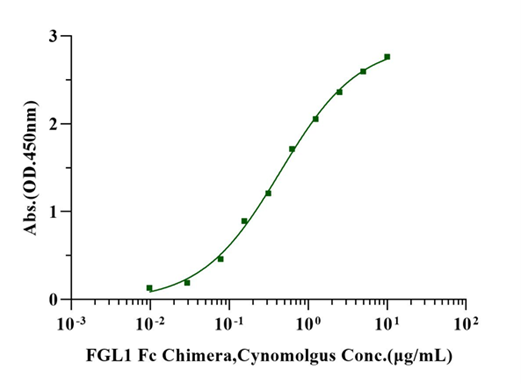
- Immobilized LAG-3/CD223 His Tag, Human (Cat. No. UA010102) at 1.0μg/mL (100μL/well) can bind FGL1 Fc Chimera, Cynomolgus (Cat. No. UA010248) with EC50 of 0.36-0.56μg/ml.
电泳
- 1μg (R: reducing condition, N: non-reducing condition).

评论(0)