


所有图片(1/1)


 分享
分享产品介绍 评论(0)
产品规格
物种
Mouse分子别名
TROP1,EpCAM,TACSTD1,CD326,DIAR5,EGP2,EGP314,EGP40,ESA,HNPCC8,HNPCC-8,KSA,M4S1,MIC18,MK1,GA733-2Accession
Q99JW5表达序列
Gln24-Thr266, with C-terminal His表达宿主
HEK293分子量
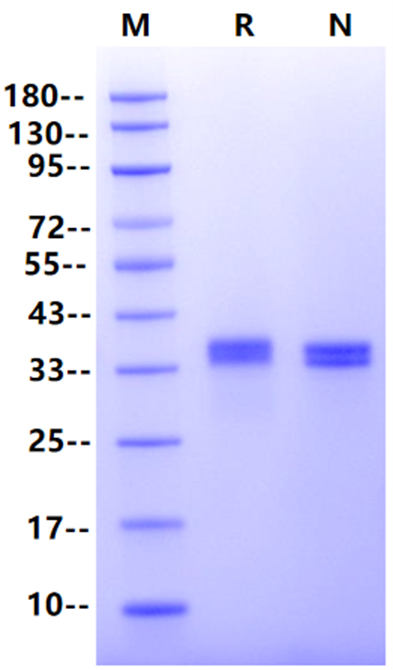
33-38kDa纯度
>95% by SDS-PAGE内毒素含量
<0.1EU/μg标记
Unconjugated标签
His Tag性状
Lyophilized Powder缓冲体系
PBS, pH7.4溶解方法
Reconstitute at 0.1-1 mg/ml according to the size in ultrapure water after rapid centrifugation.储存条件
· 12 months from date of receipt, lyophilized powder stored at -20 to -80℃.
· 3 months, -20 to -80℃ under sterile conditions after reconstitution.
· 1 week, 2 to 8℃ under sterile conditions after reconstitution.
· Please avoid repeated freeze-thaw cycles.文献引用
1、Brunner A. et al. (2008) EpCAM is predominantly expressed in high grade and advanced stage urothelial carcinoma of the bladder. J Clin Pathol. 61(3):307-310.
2、Trzpis M. et al. (2008) EpCAM in morphogenesis. Front Biosci. 13: 5050-5055.
3、Munz M. et al. (2009) The emerging role of EpCAM in cancer and stem cell signaling. Cancer Res. 69(14): 5627-5629.
4、Carpenter G. et al. (2009) EpCAM: another surface-to-nucleus missile. Cancer Cell. 15(3): 165-166.
背景介绍
- Epithelial Cellular Adhesion Molecule (EpCAM), also known as KS1/4, gp40, GA733-2, 17-1A, and TROP‑1, is a 40 kDa transmembrane glycoprotein that consists of a 242 amino acid (aa) extracellular domain with two EGF‑like repeats, a 23 aa transmembrane segment, and a 26 aa cytoplasmic domain. It modulates cell adhesion and proliferation. Its overexpression has been detected in many epithelial tumours and has been associated with high stage, high grade and a worse survival in some tumour types. EpCAM has been shown to function as a calcium-independent homophilic cell adhesion molecule that does not exhibit any obvious relationship to the four known cell adhesion molecule superfamilies. However, recent insights have revealed that EpCAM participates in not only cell adhesion, but also in proliferation, migration and differentiation of cells. In addition, recent study revealed that EpCAM is the Wnt-beta-catenin signaling target gene and may be used to facilitate prognosis. It has oncogenic potential and is activated by release of its intracellular domain, which can signal into the cell nucleus by engagement of elements of the wnt pathway.
电泳
- 1μg (R: reducing conditions, N: non-reducing conditions).

评论(0)