




 分享
分享产品介绍 评论(0)
物种
Human分子别名
CD19,B4,CVID3,MGC12802Accession
P15391表达序列
Pro20-Lys291
表达宿主
HEK293分子量
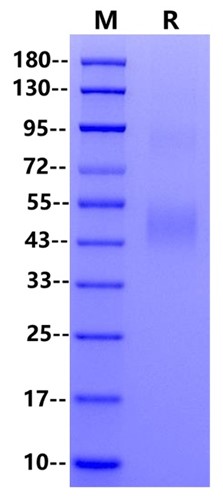
44-55kDa
纯度
>95% by SDS-PAGE
内毒素含量
<0.1EU/μg标记
FITC标签
His Tag性状
Liquid缓冲体系
PBS, pH7.4
溶解方法
Reconstitute at 0.1-1 mg/ml according to the size in ultrapure water after rapid centrifugation.
储存条件
· 12 months from date of receipt stored at --20 to -80℃.
· 1 week, 2 to 8℃ under sterile conditions
· Recommend to aliquot the protein into smaller quantities for optimal storage.
· Please avoid repeated freeze-thaw cycles.
文献引用
1、Tedder T F. et al. (1997) The CD19–CD21 Complex Regulates Signal Transduction Thresholds Governing Humoral Immunity and Autoimmunity. Immunity. 6(2): 107-118.
2、Deaglio S. et al. (2007) CD38/CD19: a lipid raft–dependent signaling complex in human B cells. Blood. 109(12): 5390-5398.
3、Engels N. et al. (2016) Signal Transduction by the B Cell Antigen Receptor. Encyclopedia of Immunobiology. 3: 44-50.
4、Oliveira S N D. et al. (2013) A CD19/Fc fusion protein for detection of anti-CD19 chimeric antigen receptors. J Transl Med. 11(1): 23.
CD19 is a type-I transmembrane glycoprotein of 95 kDa that belongs to the immunoglobulin superfamily and is widely expressed on B cells throughout most stages of B-cell differentiation, though its expression is down-regulated during their terminal differentiation to plasma cells. CD19 maps to chromosome 16p11.2, where it encodes a 540 amino acid protein with two extracellular C-type IgSF domains as well as a large, approximately 240 residue, cytoplasmic tail that exhibits extensive conservation between mice and humans. CD19 is a signal amplifying coreceptor whose expression is restricted to B cells and follicular dendritic cells. CD19 exists in a multimolecular complex with CD21 (complement receptor type 2, CR2), the tetraspanin CD81 and CD225 on the B cell surface. Via its interaction with CD21, CD19 serves as a signal transducing device for complement-conjugated antigen in B cells. Coligation of the BCR and the CD19/CD21 complex lowers the threshold for B cell activation by approximately two orders of magnitude. CD19 is a potential target for monoclonal antibody therapy, and preliminary data have demonstrated its effectiveness in B-cell depletion, making this an attractive therapy for autoimmune disorders and treatment of malignant B-cell lymphomas. CD19 serves as an attractive target for immunotherapy for many reasons: (1) It is expressed on most B-cell malignancies; (2) it is expressed in the B-cell lineage at an early stage, even before the expression of CD20; (3) it internalizes efficiently in lymphoma tumor models252; and (4) it is possibly involved in the development of B-cell cancers.
请严格按照推荐用量进行实验,分群不明显情况下,可适当提高2-5倍推荐用量。
流式分析
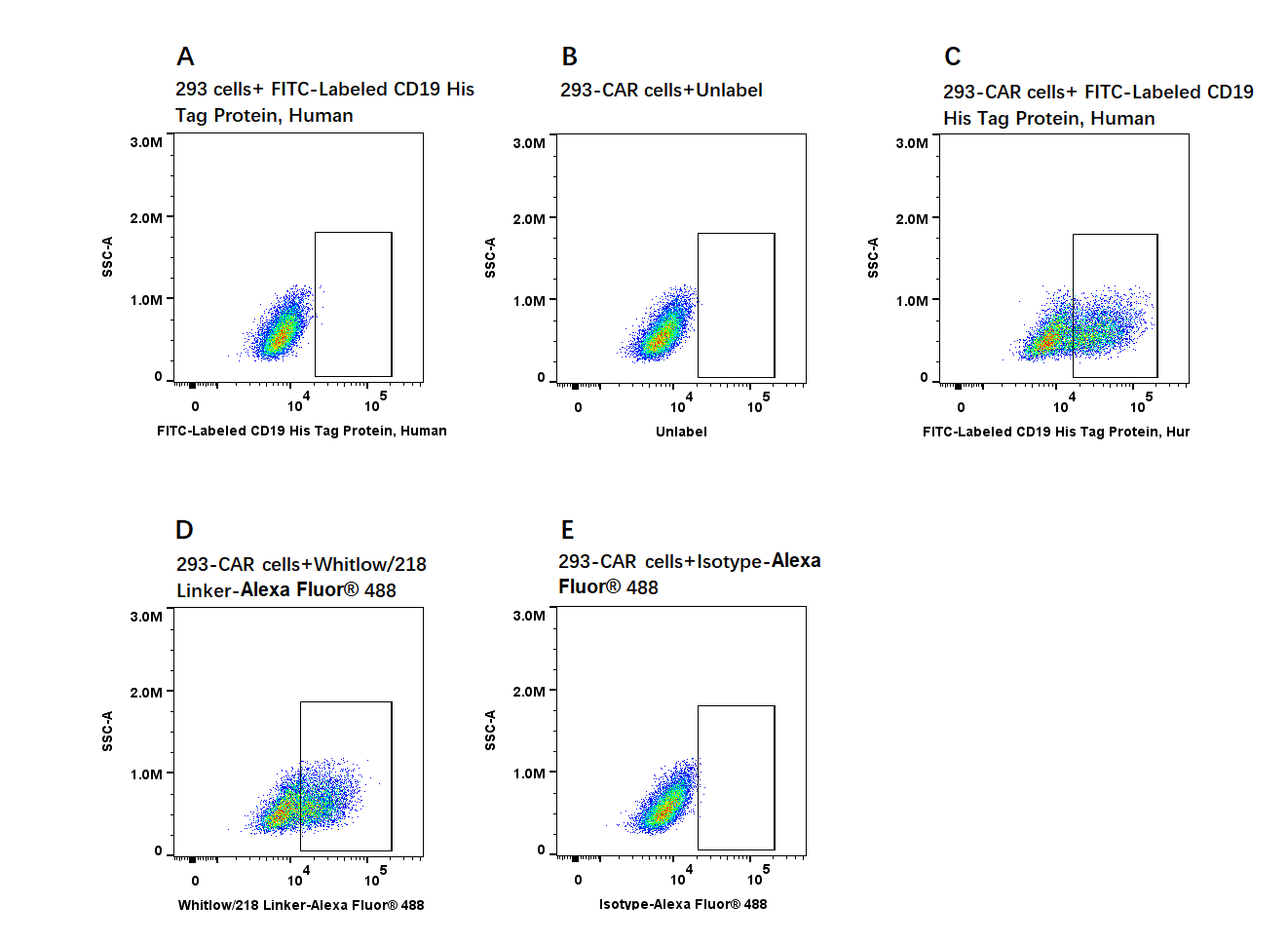
2e5 of transient transfected anti- CD19 ScFv CAR-293 cells were stained with 0.1ug FITC-Labeled CD19 His Tag Protein, Human, (Cat. No. UA010212 ) and unlable respectively (Fig. C and B), and non-transfected 293 cells were used as a control (Fig. A). FITC signal was used to evaluate the binding activity.
2e5 of transient transfected anti- CD19 ScFv CAR-293 cells were stained with isotype and Whitlow/218 Linker-Alexa Fluor® 488 (Fig. D and E). Alexa Fluor® 488 signal was used to evaluate the binding activity.
生物活性
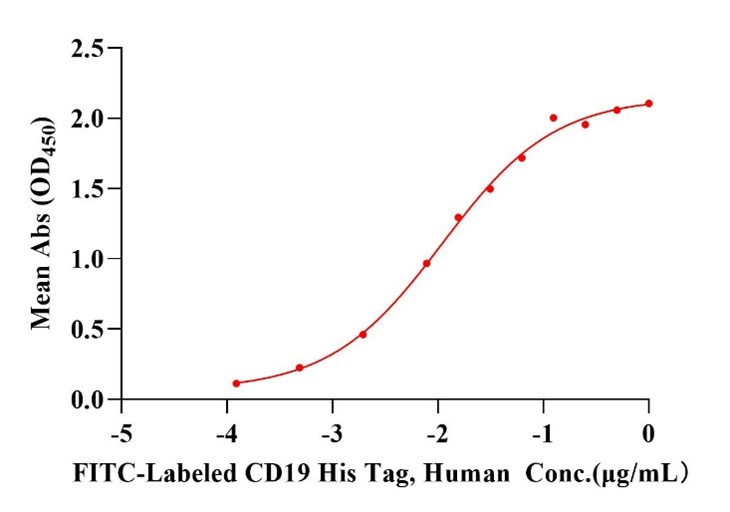
- Immobilized Anti-CD19 Antibody, Mouse Monoclonal at 0.5μg/mL (100μL/well) can bind FITC-Labeled CD19 His Tag, Human (Cat. No. UA010212) with EC50 of 10.98g/ml.
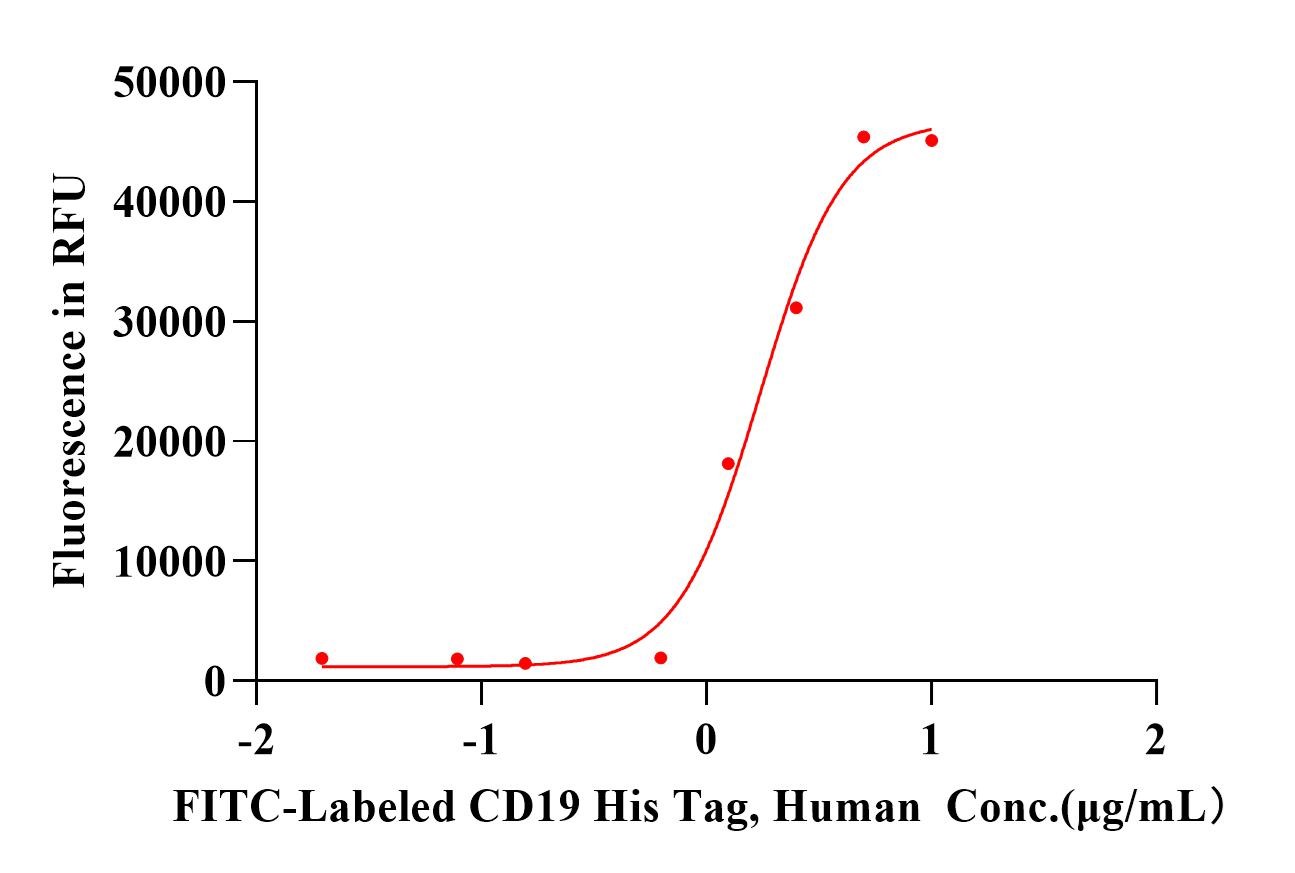
- Immobilized Anti-CD19 Antibody, Mouse Monoclonal at 2μg/mL (100μL/well) can bind FITC-Labeled CD19 His Tag, Human (Cat. No. UA010212) with EC50 of 1.728μg/ml.
电泳
- 1μg(R: reducing conditions).

评论(0)