




 分享
分享产品介绍 评论(0)
物种
Human分子别名
Glypican-3Accession
P51654-1表达序列
Gln25-His559, with C-terminal 10*His
表达宿主
HEK293分子量
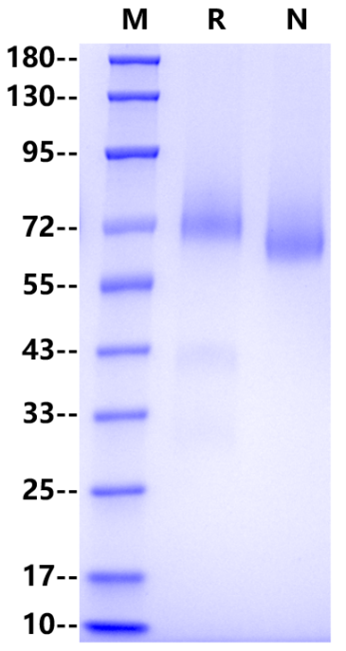
32kDa, 40kDa and 68-75kDa (Reducing) due to glycosylation
纯度
>95% by SDS-PAGE内毒素含量
<0.1EU/μg标记
Unconjugated标签
His Tag性状
Lyophilized Powder缓冲体系
PBS, pH7.4
溶解方法
Reconstitute at 0.1-1 mg/ml according to the size in ultrapure water after rapid centrifugation.
储存条件
· 12 months from date of receipt, lyophilized powder stored at -20 to -80℃.
· 3 months, -20 to -80℃ under sterile conditions after reconstitution.
· 1 week, 2 to 8℃ under sterile conditions after reconstitution.
· Please avoid repeated freeze-thaw cycles.
Glypican-3 (GPC3) belongs to a six-member family of membrane-bound heparan sulfate proteoglycans with a gene that is localized to Xq26.2. GPC3 belongs to a family of cell-surface heparan sulfate proteoglycans and is highly expressed during embryogenesis and organ development. GPC3 has limited expression in adult tissues, including lung, ovaries, mammary epithelium, and mesothelium. Normally, the liver does not express detectable levels of GPC3, but it has been observed to be highly upregulated in hepatocellular carcinomas and hepatoblastomas. Glypican-3 has been shown to play a role in the control of cell growth through the induction of apoptosis. Mutations in glypican-3 result in cell overgrowth. Among all mammalian glypicans, only mutation of GPC3 is associated with a phenotype in humans. GPC3 spans more than 500 kb of genomic DNA and contains 8 exons. Loss-of-function mutations in GPC3 result in overgrowth of many organs (Simpson-Golabi-Behmel syndrome), including the liver, which has been confirmed using GPC3-deficient mice. This observation suggests that GPC3 plays a role in growth suppression and organ size control. GPC3 is highly expressed in yolk sac tumors and choriocarcinomas, with a cytoplasmic staining pattern. It is only variably expressed in teratomas and is absent in germinomas and embryonic carcinomas.
流式分析
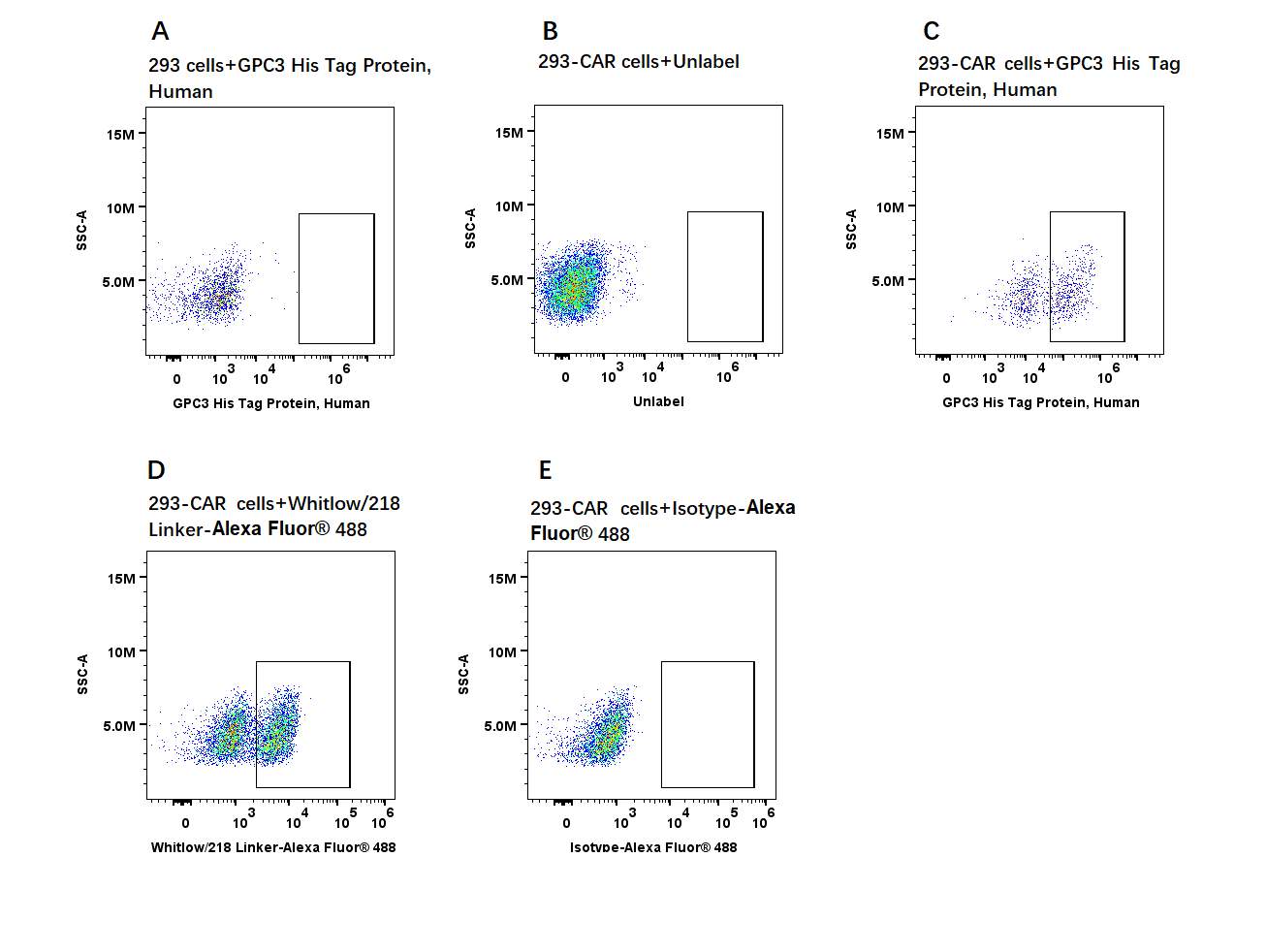
2e5 of transient transfected anti-GPC3 ScFv CAR-293 cells were stained with 0.01ug GPC3 His Tag Protein, Human, (Cat. No. UA010073) and unlable respectively (Fig. C and B), and non-transfected 293 cells were used as a control (Fig. A). Alexa Fluor 647 signal was used to evaluate the binding activity. 2e5 of transient transfected anti- GPC3 ScFv CAR-293 cells were stained with isotype and Whitlow/218 Linker-Alexa Fluor® 488 (Fig. D and E). Alexa Fluor® 488 signal was used to evaluate the binding activity.
电泳
- 1μg(R: reducing conditions, N: non-reducing conditions).
ELISA
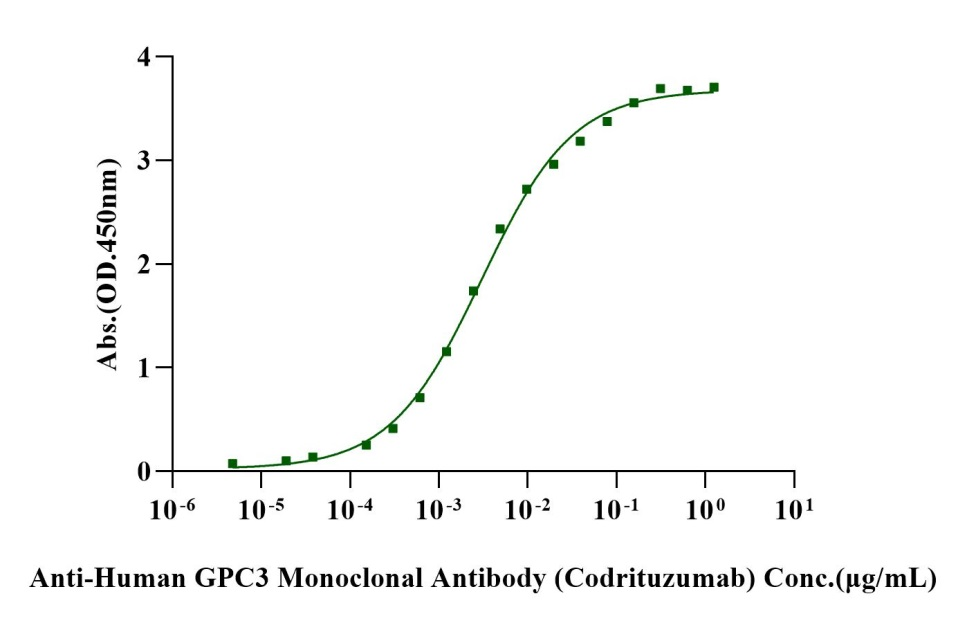
Immobilized GPC3 His Tag, Human (Cat. No. UA010073) at 2.0μg/mL (100μL/well) can bind Anti-Human GPC3 Monoclonal Antibody (Codrituzumab) with EC50 of 2.61-3.51ng/mL.
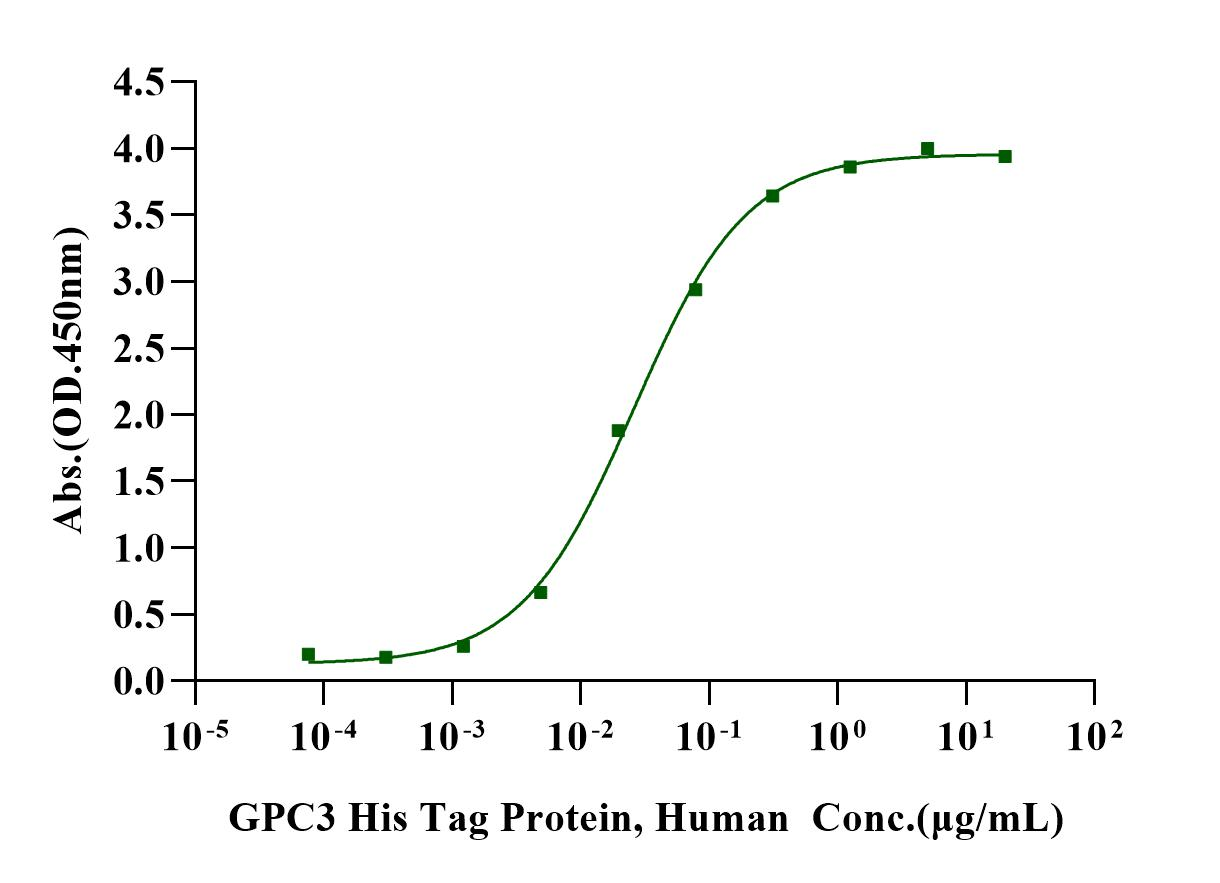
Immobilized FGF-basic(146aa) Protein, Human (Cat. No. UA040145) at 2.0μg/mL (100μL/well) can bind GPC3 His Tag Protein, Human (Cat. No. UA010073) with EC50 of 21.65-30.89ng/ml.
Immobilized FGF-basic(154aa) Protein, Human (Cat. No. UA040007) at 2.0μg/mL (100μL/well) can bind GPC3 His Tag Protein, Human (Cat. No. UA010073) with EC50 of 11.98-19.94ng/mL.

评论(0)