




 分享
分享产品介绍 评论(0)
物种
Canine分子别名
PentraxinAccession
T2KEN6表达序列
Protein sequence(T2KEN6, ·Gln20-Ser223, with C-10*His) QIDLDEKAFVFPRESENSYVILFPQLQKPMKAFTVCLQVYTDLTRPHSLFSYATKSQSNEILLFKERPGLFSVSVGGSDAFINFPQKFYAPQHFCVTWESVTGLTELWVDGKPMVRASLRRGYTVGSGASIVLGQEQDSFGGGFDKNQSLVGDIEDVNMWDFVLSPSQILTLYTTRALSPNVLNWRNLRYETRGEVFLKKELWSGGGGSHHHHHHHHHH
表达宿主
HEK293分子量
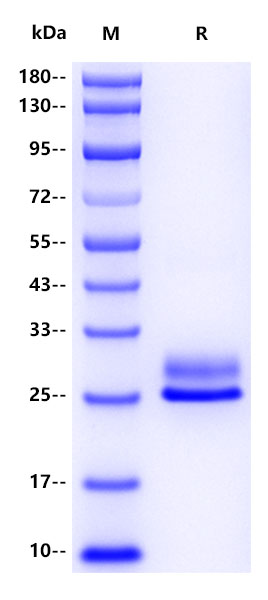
Theoretical:24.8kDa Actual:25, 29kDa纯度
>95% by SDS-PAGE内毒素含量
<1EU/μg标记
Unconjugated标签
His Tag性状
Lyophilized Powder缓冲体系
Lyophilized from a 0.2 μm filtered solution of 0.2M PBS, pH7.4.溶解方法
Reconstitute no more than 1 mg/mL according to the size in deionized water after rapid centrifugation.储存条件
12 months from date of receipt, -20 to -70 °C as supplied. 6 months.
-20 to -70 °C under sterile conditions after reconstitution.
1 week, 2 to 8 °C under sterile conditions after reconstitution.
Please avoid repeated freeze-thaw cycles.
C-reactive protein (CRP) is an annular (ring-shaped) pentameric protein found in blood plasma, whose circulating concentrations rise in response to inflammation. It is an acute-phase protein of hepatic origin that increases following interleukin-6 secretion by macrophages and T cells. Its physiological role is to bind to lysophosphatidylcholine expressed on the surface of dead or dying cells (and some types of bacteria) in order to activate the complement system via C1q. CRP is used mainly as an inflammation marker. Apart from liver failure, there are few known factors that interfere with CRP production. Interferon alpha inhibits CRP production from liver cells which may explain the relatively low levels of CRP found during viral infections compared to bacterial infections.
电泳
2μg(R: reducing conditions)

评论(0)