




 分享
分享产品介绍 评论(0)
物种
Canine分子别名
T-cell surface antigen T4/Leu-3表达序列
Protein sequence (P33705, Val25-Lys401, with C-10*His) VREVVLGKAGDAVELPCQTSQKKNIHFNWRDSSMVQILGNQGSFWTVGSSRLKHRVESKKNLWDQGSFPLVIKDLEVADSGIYFCDTDKRQEVELLVFNLTAKWDSGSSSGSSNIRLLQGQQLTLTLENPSGSSPSVQWKGPGNKSKHGGQNLSLSWPELQDGGTWTCIISQSQKTVEFNINVLVLAFQKVSNTFYAREGDQVEFSFPLSFEDENLVGELRWQAQGASSSLLWISFTLENRKLSMKEAHAPLKLQMKESLPLRFTLPQVLSRYAGSGILTLNLAKGTLYQEVNLVVMRANSSQNNLTCEVLGPTSPELTLSLNLKEQAAKVSKQQKLVWVVDPEGGTWQCLLSDKDKVLLASSLNVSSPVVIKSWPKGGGGSHHHHHHHHHH
表达宿主
HEK293分子量
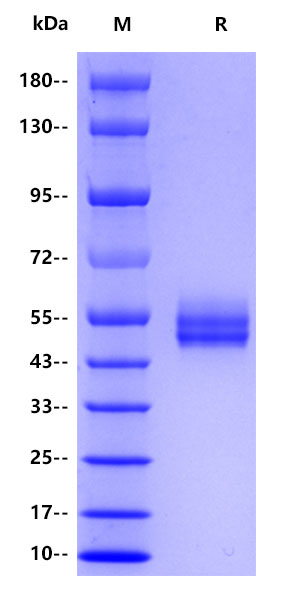
Predicted MW: 43.4 kDa Observed MW: 50, 54 kDa纯度
>95% by SDS-PAGE标签
with C-10*His性状
Lyophilized Powder缓冲体系
Lyophilized from a 0.2 μm filtered solution of 0.2M PBS, pH7.4.溶解方法
Reconstitute no more than 1 mg/mL according to the size in deionized water after rapid centrifugation.储存条件
12 months from date of receipt, -20 to -70 °C as supplied. 6 months, -20 to -70 °C under sterile conditions after reconstitution. 1 week, 2 to 8 °C under sterile conditions after reconstitution. Please avoid repeated freeze-thaw cycles.
CD4 (cluster of differentiation 4) is a glycoprotein that serves as a co-receptor for the T-cell receptor (TCR). CD4 is found on the surface of immune cells such as T helper cells, monocytes, macrophages, and dendritic cells. It was discovered in the late 1970s and was originally known as leu-3 and T4 (after the OKT4 monoclonal antibody that reacted with it) before being named CD4 in 1984. CD4+ T helper cells are white blood cells that are an essential part of the human immune system. They are often referred to as CD4 cells, T-helper cells or T4 cells. They are called helper cells because one of their main roles is to send signals to other types of immune cells, including CD8 killer cells, which then destroy the infectious particle.
电泳
2μg(R: reducing conditions)

评论(0)