




 分享
分享产品介绍 评论(0)
物种
Human分子别名
Ig lambda chain C region MGC, Ig lambda-1 chain C region, IGLC1Accession
P0CG04表达序列
Protein sequence(P0CG04, Gly1-Ser106, with C-10*His) GQPKANPTVTLFPPSSEELQANKATLVCLISDFYPGAVTVAWKADGSPVKAGVETTKPSKQSNNKYAASSYLSLTPEQWKSHRSYSCQVTHEGSTVEKTVAPTECSGGGGSHHHHHHHHHH
表达宿主
CHO分子量
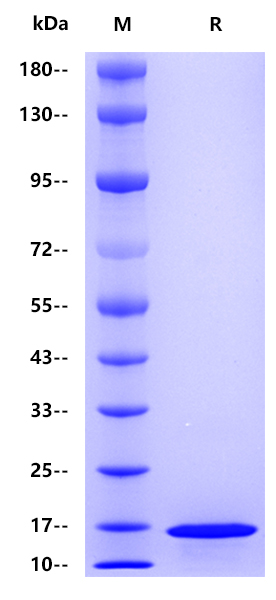
Theoretical:13.0kDa Actual:16.0kDa纯度
>95% by SDS-PAGE
内毒素含量
<1EU/μg标签
His Tag性状
Lyophilized Powder缓冲体系
Lyophilized from a 0.2 μm filtered solution of 0.2M PBS, pH7.4.溶解方法
Reconstitute no more than 1 mg/mL according to the size in deionized water after rapid centrifugation.储存条件
12 months from date of receipt, -20 to -70 °C as supplied. 6 months, -20 to -70 °C under sterile conditions after reconstitution. 1 week, 2 to 8 °C under sterile conditions after reconstitution. Please avoid repeated freeze-thaw cycles.
The immunoglobulin light chain is the small polypeptide subunit of an antibody (immunoglobulin). There are two types of light chain in humans: kappa (κ) chain and lambda (λ) chain. Individual B-cells in lymphoid tissue possess either kappa or lambda light chains, but never both together. Specific rearrangement of lambda light chain of immunoglobulins can lead to loss of some protein coding genes. Using immunohistochemistry, it is possible to determine the relative abundance of B-cells expressing kappa and lambda light chains. If the lymph node or similar tissue is reactive, or otherwise benign, it should possess a mixture of kappa positive and lambda positive cells. If, however, one type of light chain is significantly more common than the other, the cells are likely all derived from a small clonal population, which may indicate a malignant condition, such as B-cell lymphoma.
电泳
2μg(R: reducing conditions)

评论(0)